
Skip to main navigation Skip to main content
  • KAPS
  • E-Submission

APS : Advances in Pediatric Surgery

OPEN ACCESS
ABOUT
BROWSE ARTICLES
EDITORIAL POLICY
FOR CONTRIBUTORS
Original Article

Primary Laparoscopic-Assisted Endorectal Pull-Through for Hirschsprung's Disease

Journal of the Korean Association of Pediatric Surgeons 2013;19(2):130-139.
Published online: December 24, 2013

Department of Surgery, Chungnam National University School of Medicine, Daejeon, Korea.

Correspondence: Ji-Young Sul, M.D., Department of Surgery, Chungnam National University School of Medicine, 282 Munhwa-ro, Jung-gu, Daejeon 301-721, Korea. Tel: 042)280-7182, Fax: 042)257-8024, jysul@cnu.ac.kr
• Received: October 24, 2013   • Accepted: November 30, 2013

Copyright © 2013 Korean Association of Pediatric Surgeons

  • 7 Views
  • 0 Download
prev next
  • The application of laparoscopic techniques for the surgical management of Hirschsprung's disease is the recent trend. We described the surgical technique and postoperative long-term outcomes of the one-stage, laparoscopic-assiseted endorectal pull-through operation for Hirschsprung's disease. The technique uses three to four small abdominal ports. Laparoscopic mobilization of the sigmoid colon and rectum is performed and marginal artery-preserving colon pedicle is prepared. The rectal mobilization is performed using a transanal endorectal sleeve technique. The anastomosis is performed 0.5~1 cm above the dentate line. The age at surgery ranged from 6 days to 4 years. The average operative time was 144 minutes. Almost all of the patients passed stool and flatus within 36 hours of surgery. The average hospital stay after surgery was 6.5 days. Among 42 patients, 32 patients older than 3 years old were evaluated for function on defecation. All 32 patients have been continent, of those who needed laxatives were 11 (34.3%) due to constipation and overflow incontinence. Four children (12.5%) have remained dependent on laxatives. Laparoscopic-assisted endorectal pull-through operation for Hirschsprung's disease appears to be safe, provides the less pain, shorter time to full feeding, shorter hospital stay, and excellent cosmetic outcomes. Helping patients and parents ensure the quality of life, they should be provided with counseling, education, and longer-term follow-up care.
  • 1. Teitelbaum DH. Hirschsprung's disease. In O'Neill JA Jr, Grosfeld JL, Fonkalsrud EW, Coran AG, Caldamone AA, eds, ddPrinciples of Pediatric Surgery. ed 2. St. Louis: Mosby; 2004, pp 573-586.
  • 2. Gunnarsdóttir A, Wester T. Modern Treatment of Hirschsprung's disease. Scand J Surg 2011;100:243-249.
  • 3. Swenson O. Hirschsprung's disease-a complicated therapeutic problem: some thoughts and solutions based on data and personal experience over 56 years. J Pediatr Surg 2004;39:1449-1453.
  • 4. Chatoorgoon K, Pena A, Lawal TA, Levitt M. The Problematic Duhamel Pouch in Hirschsprung's disease: manifestations and treatment. Eur J Pediatr Surg 2011;21:366-369.
  • 5. Soave F. A new surgical technique for the treatment of Hirschsprung's disease. Surgery 1964;56:1007-1044.
  • 6. Haricharan RN, Georgeson KE. Hirschsprug disease. Semin Pediatr Surg 2008;17:266-275.
  • 7. Doughty D, Junkin J, Kurz P, Selekof J, Gray M, Fader M, Bliss DZ, Beeckman D, Logan S. Incontinence-Associated Dermatitis Consensus Statement, Evidence-Based Guidelines for Prevention and Treatment, and Current Challenges. J Wound Ostomy Continence Nurs 2012;39:303-315.
  • 8. Dasgupta R, Langer JC. Transanal pull-through for Hirschsprung disease. Semin Pediatr Surg 2005;14:64-71.
  • 9. Dasgupta R, Langer JC. Hirschsprung disease. Curr Probl Surg 2004;41:942-988.
  • 10. van de Ven TJ, Sloots CE, Wijnen MH, Rassouli R, van Rooij I, Wijnen RM, de Blaauwl I. Transanal endorectal pull-through for classic segment Hirschsprung's disease: With or without laparoscopic mobilization of the rectosigmoid. J Ped Surg 2013;48:1914-1918.
  • 11. Hollwarth ME, Rivosecchi M, Schleef J, Deluggi S, Fasching G, Ceriati E, Ciprandi G, DePeppo F. The role of transanal endorectal pull-through in the treatment of Hirschsprung's disease- A multicenter experience. Pediatr Surg Int 2002;18:344-348.
  • 12. Georgeson KE, Robertson DJ. Laparoscopic-assisted approaches for the definitive surgery for Hirschsprung's disease. Semin Pediatr Surg 2004;12:256-262.
  • 13. Craigie RJ, Conway SJ, Cooper L, Turnock RR, Lamont GS, Baillie CT, Kenny SE. Primary pull-through for Hirschsprung's disease: Comparison of open and laparoscopic-assisted procedures. J Laparoendosc Adv Surg Tech A 2007;17:809-812.
  • 14. Hassan HS, Hashish AA, Fayad H, Elian A, Elatar A, Afify M, Elhalaby EA. Redo Surgery for Hirschsprung's disease. Ann Pediatr Surg 2008;4:42-50.
  • 15. Nasr A, Langer JC. Evolution of the technique in the transanal pull-through for Hirschsprung's disease: effect on outcome. J Pediatr Surg 2007;42:36-39.
  • 16. Tang ST, Wang GB, Cao GQ, Wang Y, Mao YZ, Li SW, Li S, Yang Y, Yang J, Yang I. 10 years of experience with laparoscopic-assisted endorectal Soave pull-through procedure for Hirschsprung's disease in China. J Laparoendosc Adv Surg Tech A 2012;22:280-284.
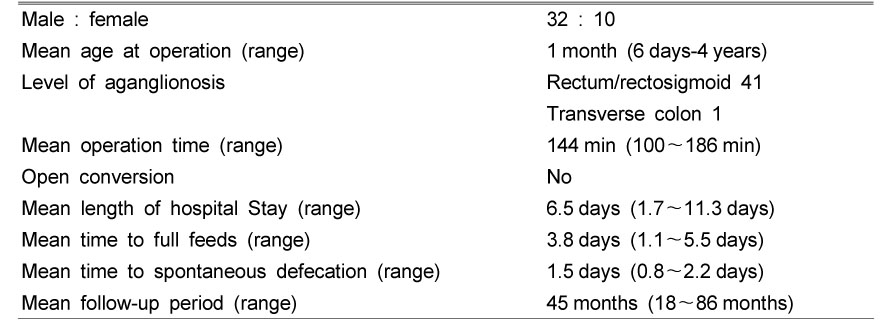
Table 1
General Patients and Surgical Characteristics
jkaps-19-130-i001.jpg
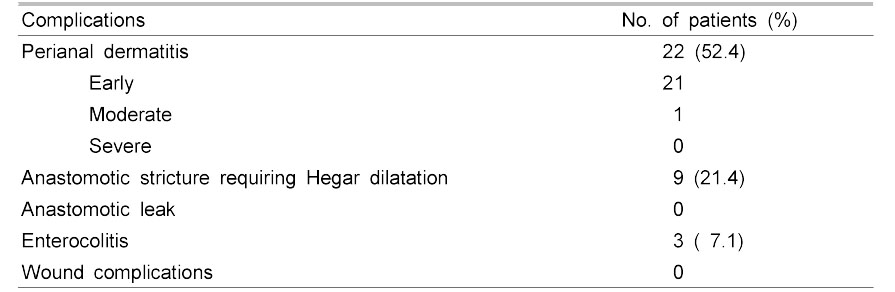
Table 2
Early Postoperative Complications (<3 Months after Surgery)
jkaps-19-130-i002.jpg
Table 3
Late Postoperative Complications and Long-term Outcomes (>3 Months after Surgery)
jkaps-19-130-i003.jpg
Table 4
Functional Results of Krickenbeck Assessment (N=32 Patients >3 Years Old)

*Voluntary bowel movement: feeling of urge, capacity to verbalize, hold the bowel movement

Soiling: Grade 1 occasionally (once or twice per week); Grade 2 every day, no social problem; Grade 3 constant, social problem

+Constipation: Grade 1 manageable with diet; Grade 2 requires laxatives; Grade 3 resistant to diet and laxatives

jkaps-19-130-i004.jpg

Download Citation

Download a citation file in RIS format that can be imported by all major citation management software, including EndNote, ProCite, RefWorks, and Reference Manager.

Format:

Include:

Primary Laparoscopic-Assisted Endorectal Pull-Through for Hirschsprung's Disease
J Korean Assoc Pediatr Surg. 2013;19(2):130-139.   Published online December 24, 2013
Download Citation

Download a citation file in RIS format that can be imported by all major citation management software, including EndNote, ProCite, RefWorks, and Reference Manager.

Format:
Include:
Primary Laparoscopic-Assisted Endorectal Pull-Through for Hirschsprung's Disease
J Korean Assoc Pediatr Surg. 2013;19(2):130-139.   Published online December 24, 2013
Close
Primary Laparoscopic-Assisted Endorectal Pull-Through for Hirschsprung's Disease

General Patients and Surgical Characteristics

Early Postoperative Complications (<3 Months after Surgery)

Late Postoperative Complications and Long-term Outcomes (>3 Months after Surgery)

Functional Results of Krickenbeck Assessment (N=32 Patients >3 Years Old)

*Voluntary bowel movement: feeling of urge, capacity to verbalize, hold the bowel movement

Soiling: Grade 1 occasionally (once or twice per week); Grade 2 every day, no social problem; Grade 3 constant, social problem

+Constipation: Grade 1 manageable with diet; Grade 2 requires laxatives; Grade 3 resistant to diet and laxatives

Table 1 General Patients and Surgical Characteristics
Table 2 Early Postoperative Complications (<3 Months after Surgery)
Table 3 Late Postoperative Complications and Long-term Outcomes (>3 Months after Surgery)
Table 4 Functional Results of Krickenbeck Assessment (N=32 Patients >3 Years Old)

*Voluntary bowel movement: feeling of urge, capacity to verbalize, hold the bowel movement

Soiling: Grade 1 occasionally (once or twice per week); Grade 2 every day, no social problem; Grade 3 constant, social problem

+Constipation: Grade 1 manageable with diet; Grade 2 requires laxatives; Grade 3 resistant to diet and laxatives