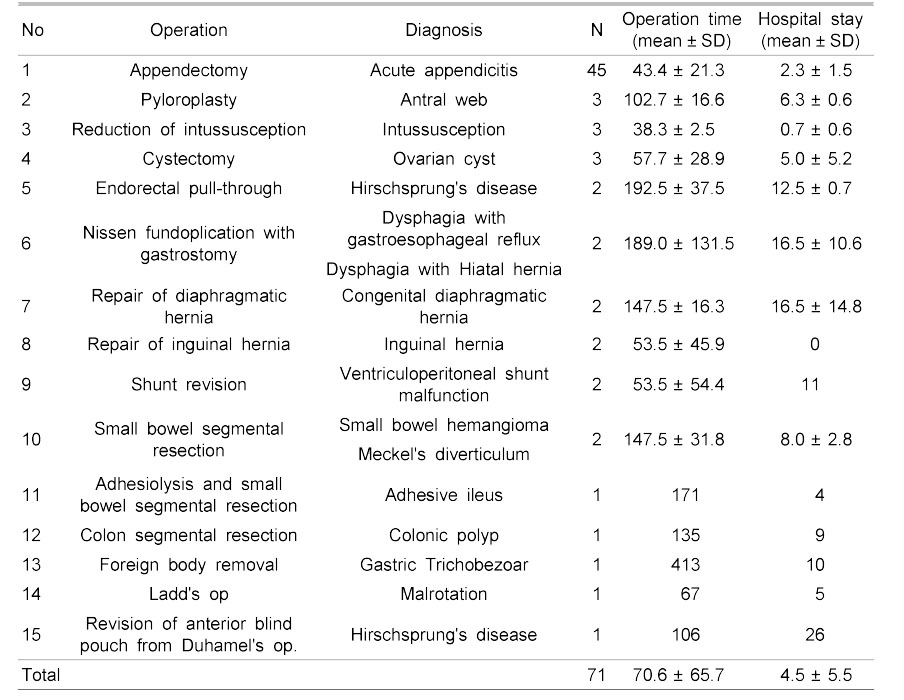
Laparoscopic surgery has become popular in the past few decades, owing to less postoperative pain, fast recovery, and better cosmetic outcomes. The laparoscopic approach has been employed in pediatric surgery for the same reasons. After the first attempts of single incision laparoscopic appendectomy in pediatrics in 1998, single incision laparoscopic surgery (SILS) has recently been proven to be safe and feasible for the pediatric population. However, limitations have been reported for SILS, such as the wide learning curve, compared to standard laparoscopic surgery, and the restricted number of hospitals with surgical training programs including SILS. In this study, we intend to present our initial experiences with SILS in children, and to describe the technique, instruments used, and outcomes. This is a retrospective study of 71 pediatric patients who underwent SILS, at a tertiary medical center, between September, 2012 and August, 2013. Electronic medical records were reviewed for demographics, type of procedure, operation time, use of additional ports, conversion to open surgery, complications and hospital stay. Additional ports were inserted in 4 cases, for the purpose of traction. Postoperative complications were noted in 13 cases, which were mostly related to wound inflammation or formation of granulation tissue. According to our analyses, patients with complications had significantly longer use and more frequent use of pain killers. Notwithstanding the small sample size, many of the procedures performed in pediatric patients seem to be possible with SILS.
2. Pelosi MA, Pelosi MA 3rd. Laparoscopic supracervical hysterectomy using a single-umbilical puncture (mini-laparoscopy). J Reprod Med 1992;37:777-784.
6. Dutta S. Early experience with single incision laparoscopic surgery: eliminating the scar from abdominal operations. J Pediatr Surg 2009;44:1741-1145.
8. Yannam GR, Griffin R, Anderson SA, Beierle EA, Chen MK, Harmon CM. Single incision pediatric endosurgery (SIPES) appendectomy - is obesity a contraindication? J Pediatr Surg 2013;48:1399-1404.
10. Islam S, Adams SD, Mahomed AA. SILS: Is it cost- and time-effective compared to standard pediatric laparoscopic surgery? Minim Invasive Surg 2012;2012:807609.
14. Hass EM, Nieto J, Raqupathi M, Aminian A, Patel CB. Critical appraisal of learning curve for single incision laparoscopic right colectomy. Surg Endosc 2013;Jul. 23. Epub ahead of print.
15. Hopping JR, Bardakcioqlu O. Single-port laparoscopic right hemicolectomy: the learning curve. JSLS 2013;17(2):194-197.
16. Lacher M, Muensterer OJ, Yannam GR, Aprahamian CJ, Perger L, Megison M, Yu DC, Beierle EA, Anderson SA, Chen MK, Harmon CM. Feasibility of single-incision pediatric endosurgery for treatment of appendicitis in 415 children. J Laparoendosc Adv Surg Tech A 2012;22:604-608.
17. Szavay PO, Luithle T, Nagel C, Fuchs J. Weight-adapted surgical approach for laparoendoscopic single-site surgery in pediatric patients using low-cost reusable instrumentation: a prospective analysis. J Laparoendosc Adv Surg Tech A 2013;23:281-286.
Cases Using Assist Ports in addition to Gloveport®
Figure & Data
References
Citations
Citations to this article as recorded by
One-year experience with single incision laparoscopic cholecystectomy in a single center: without the use of inverse triangulation Yun Beom Ryu, Jung Woo Lee, Yo Han Park, Man Sup Lim, Ji Woong Cho, Jang Yong Jeon Annals of Surgical Treatment and Research.2016; 90(2): 72. CrossRef
Surgical Outcomes of Single-port Laparoscopic Appendectomy versus Conventional Laparoscopic Appendectomy in Children: Preliminary Report of a Prospective Randomized Trial Jung Rae Cho, Won Me Kang, Soo Min Ahn Journal of the Korean Association of Pediatric Surgeons.2014; 20(2): 48. CrossRef