

Skip to main navigation Skip to main content
  • KAPS
  • E-Submission

APS : Advances in Pediatric Surgery

OPEN ACCESS
ABOUT
BROWSE ARTICLES
EDITORIAL POLICY
FOR CONTRIBUTORS

Page Path

5
results for

"Surveys and questionnaires"

Article category

Keywords

Publication year

Authors

"Surveys and questionnaires"

Original Articles

[English]
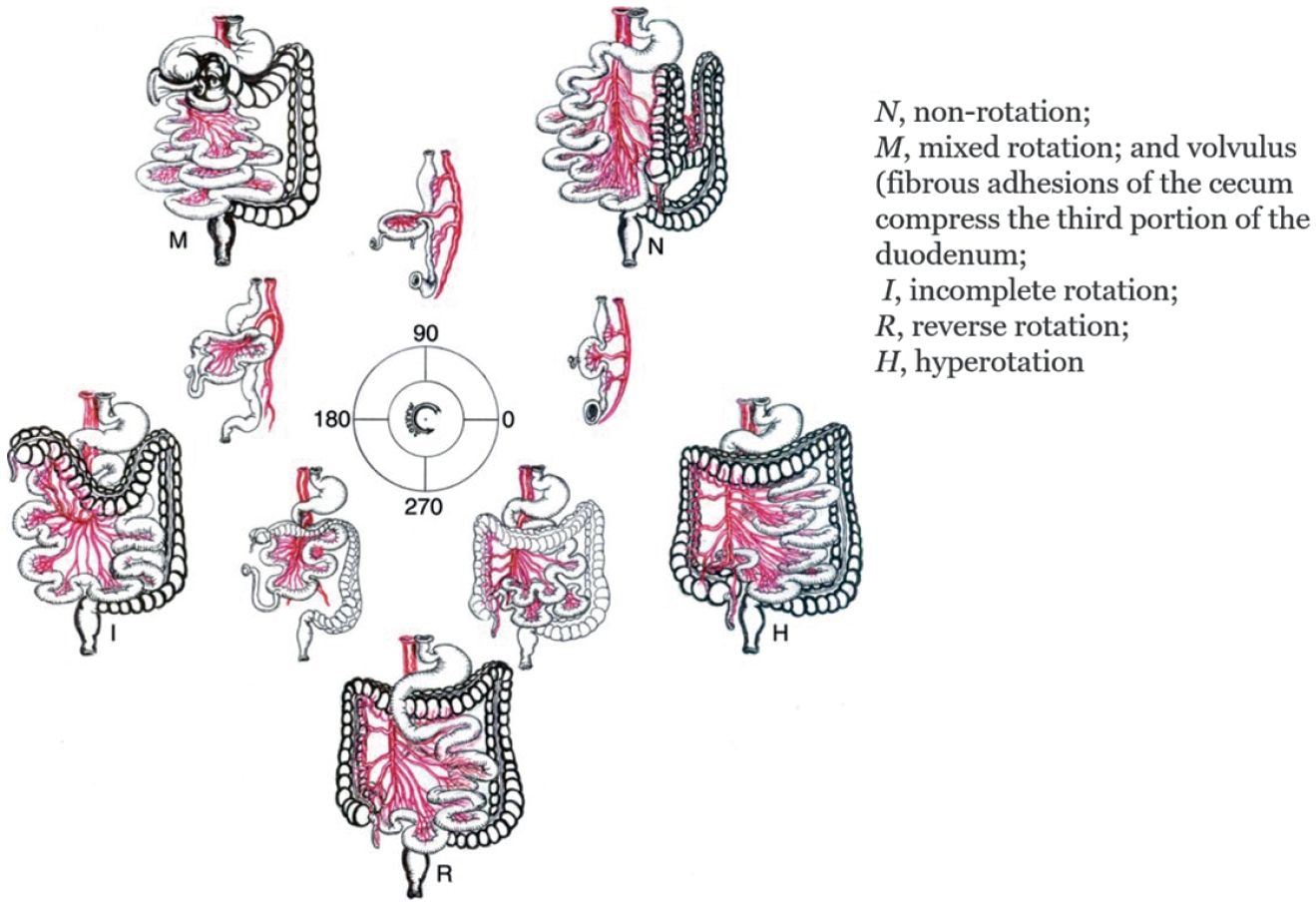
Perception on the Intestinal Malrotation: A 2021 Survey Conducted by the Korean Association of Pediatric Surgeons
Hee-Beom Yang, Min Jeng Cho, Yu Jeong Cho, Yoon Mi Choi, Jae Hee Chung, Seok Joo Han, Jeong Hong, Eunyoung Jung, Ki Hoon Kim, Soo-Hong Kim, Cheol-Gu Lee, Nam-Hyuk Lee, Ju Yeon Lee, Sanghoon Lee, Suk Bae Moon, Young-Hyun Na, So Hyun Nam, Chaeyoun Oh, Jin Young Park, Junbeom Park, Tae-Jin Park, Jae Ho Shin, Joonhyuk Son, Hyun-Young Kim, The Korean Association of Pediatric Surgeons
Adv Pediatr Surg 2025;31(2):59-65.   Published online August 5, 2025
DOI: https://doi.org/10.13029/aps.2025.31.2.59
Purpose
To report the findings of a perception survey on intestinal malrotation conducted by the Korean Association of Pediatric Surgeons (KAPS) in 2021.
Methods
The perceptions on intestinal malrotation regarding clinical decision making of the KAPS members were collected through web-based survey.
Results
A total of 22 surgeons were answered for this study. The results were presented and discussed at the 37th annual meeting of KAPS, which was held in Seoul on June 18, 2021.
Conclusion
This study provides the clinical decisions of the KAPS members on the intestinal malrotation. The study is expected to be an important reference for improving pediatric surgeons’ understanding and treatment of intestinal malrotation.
  • 28 View
  • 2 Download
[English]
Variation in Long-Term Care of Pediatric Surgery Patients: A Survey of Pediatric Surgeons in Korea
Wontae Kim, Sungjoo Park, Jeong-Meen Seo, Sanghoon Lee
Adv Pediatr Surg 2025;31(1):1-7.   Published online May 28, 2025
DOI: https://doi.org/10.13029/aps.2025.31.1.1
Purpose
This study aimed to evaluate postoperative outpatient follow-up practices among pediatric surgeons in Korea for five common congenital diseases: esophageal atresia with tracheoesophageal fistula (EA/TEF), anorectal malformation (ARM), Hirschsprung’s disease (HSCR), choledochal cyst (CC), and inguinal hernia (IH).
Methods
A web-based survey consisting of 43 questions was distributed to members of the Korean Association of Pediatric Surgeons. The survey assessed the timing, frequency, and duration of outpatient follow-up, as well as disease-specific practices.
Results
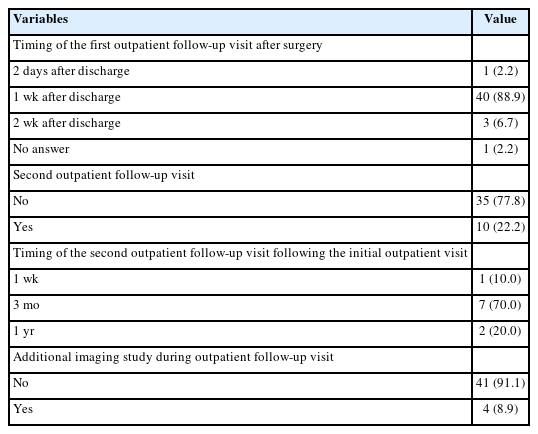
Of 154 invited surgeons, 45 (29.2%) responded. Most scheduled the first follow-up visit within one week after discharge. During the first postoperative year, follow-up visits were commonly held every three months, followed by six months or annual intervals. Most surgeons concluded follow-up before age 18; however, 15.6%–37.8% reported continuing follow-up into adulthood depending on the disease. Variation was observed in disease-specific practices: 44.4% routinely performed contrast studies for EA/TEF follow-up; sizes #14–15 Hegar dilators were most used in ARM; only 6.7% performed routine rectal irrigation in HSCR. For CC, 88.9% checked both blood tests and ultrasonography. Most IH patients received only one follow-up visit.
Conclusion
While early postoperative follow-up practices among pediatric surgeons in Korea appear relatively consistent, wide variation exists in long-term strategies and disease-specific protocols. This reflects the tendency to rely on individual clinical judgment and highlights the need for standardized, national consensus.
  • 60 View
  • 7 Download
[English]
Sacrococcygeal Teratoma: A Survey by the Korean Association of Pediatric Surgeons in 2018
Jung-Tak Oh, Hye Kyung Chang, Min Jeong Cho, Yong Hoon Cho, Soo Jin Na Choi, Yoon Mi Choi, Jae Hee Chung, Sang Young Chung, Jeong Hong, Seok Joo Han, Yeon Jun Jeong, Eunyoung Jung, Kyuhwan Jung, Dae Youn Kim, Hae-Young Kim, Hyun-Young Kim, Ki Hoon Kim, Sang Youn Kim, Seong Chul Kim, Seong Min Kim, Soo-Hong Kim, Jong-In Lee, Myung-Duk Lee, Nam-Hyuk Lee, Suk-Koo Lee, So Hyun Nam, Jin Young Park, Kwi-Won Park, Tae-Jin Park, Jeong-Meen Seo, Jae Ho Shin, Jiyoung Sul
Adv Pediatr Surg 2019;25(2):35-43.   Published online December 18, 2019
DOI: https://doi.org/10.13029/aps.2019.25.2.35
Purpose

The Korean Association of Pediatric Surgeons (KAPS) performed a nationwide survey on sacrococcygeal teratoma in 2018.

Methods

The authors reviewed and analyzed the clinical data of patients who had been treated for sacrococcygeal teratoma by KAPS members from 2008 to 2017.

Results

A total of 189 patients from 18 institutes were registered for the study, which was the first national survey of this disease dealing with a large number of patients in Korea. The results were discussed at the 34th annual meeting of KAPS, which was held in Jeonju on June 21–22, 2018.

Conclusions

We believe that this study could be utilized as a guideline for the treatment of sacrococcygeal teratoma to diminish pediatric surgeons' difficulties in treating this disease and thus lead to better outcomes.

  • 8 View
  • 0 Download

Review Article

[English]
Neonate Congenital Bochdalek Hernia: A National Survey of Its Members by Korean Association of Pediatric Surgeons
D Y Kim, S C Kim, S H Kim, H Y Kim, H Y Kim, S H Nam, K W Park, J B Park, J Y Park, Y J Boo, J M Seo, S M Ahn, J T Oh, S K Lee, S C Lee, E Y Jang, H K Jang, S E Jung, S M Jung, Y J Jung, E Y Jung, M J Cho, S O Choi, S J Han, Y J Hong, J Hong
J Korean Assoc Pediatr Surg 2016;22(1):6-9.   Published online June 30, 2016
DOI: https://doi.org/10.13029/jkaps.2016.22.1.6

This is a survey on congenital posterolateral diaphragmatic hernia, conducted by Korean Association of Pediatric Surgeons (KAPS). A registration form for each patient during the 5-year period between 2010 and 2014 and a questionnaire were sent to each member. Twenty-six members in 16 institutions returned completed forms. Total patients were 219. Prenatal diagnoses were done in 181 cases (82.6%). Preoperative mortality was 11.4%. Minimal invasive surgery was done in 61 cases (31.8%). Risk factors related with death were Apgar score, oxygenation index, preoperative pH and bicarbonate, O2 saturation, the presence of hernia sac, and the size of defect. The neonatal survival and 1-year survival of total patients were 77.6% and 75.3%.

  • 6 View
  • 0 Download

Original Article

[English]
Lymphangioma: A 2019 Survey Conducted by the Korean Association of Pediatric Surgeons
Oh, Jung-Tak , Ahn, Soo Min , Boo, Yoon-Jung , Chang, Eun Young , Chang, Hye Kyung , Choi, Soo Jin Na , Choi, Yoon Mi , Chung, Jae Hee , Chung, Sang Young , Hong, Jeong , Han, Seok Joo , Jeong, Yeon Jun , Jung, Eunyoung , Jung, Sung Eun , Kim, Dae Youn , Kim, Hyun-Young , Kim, In-Koo , Kim, Seong Chul , Lee, Ho-Kyun , Lee, Ju Yeon , Lee, Nam-Hyuk , Lee, Seong-Cheol , Lee, Suk-Koo , Namgoong, Jung-Man , Oh, Chaeyoun , Park, Jin Young , Park, Kwi-Won , Seo, Jeong-Meen , Shin, Jae Ho , Sul, Jiyoung
Adv Pediatr Surg 2022;28(1):1-8.
DOI: https://doi.org/10.13029/aps.2022.28.1.1
Purpose
Report of a nationwide survey on lymphangioma conducted by the Korean Association of Pediatric Surgeons (KAPS) in 2019.
Methods
The authors reviewed and analyzed the clinical data of pediatric patients who started treatment for lymphangioma in hospitals of KAPS members from 2011 to 2013. Their follow-up data is also included in the study.
Results
A total of 532 patients with lymphangioma from 18 institutes were registered for the study. The results were discussed at the 35th annual meeting of KAPS, which was held in Gyeongju on June 13–14, 2019.
Conclusion
This study provides general information on lymphangioma and comprehensive treatment outcomes for this disease. The study is expected to be an important reference for improving pediatric surgeons’ understanding and treatment of lymphangioma.
  • 9 View
  • 0 Download