

Skip to main navigation Skip to main content
  • KAPS
  • E-Submission

APS : Advances in Pediatric Surgery

OPEN ACCESS
ABOUT
BROWSE ARTICLES
EDITORIAL POLICY
FOR CONTRIBUTORS

Page Path

21
results for

"Survey"

Article category

Keywords

Publication year

Authors

Funded articles

"Survey"

Original Articles

[English]
Neuroblastoma: A 2020 Survey Conducted by the Korean Association of Pediatric Surgeons
Hee-Beom Yang, Soo Min Ahn, Min Jeng Cho, Yong-Hoon Cho, Soo Jin Na Choi, Yoon Mi Choi, Jae Hee Chung, Seok Joo Han, In Geol Ho, Jeong Hong, Kyong Ihn, Yeon Jun Jeong, Eunyoung Jung, Dae Youn Kim, Hae-Young Kim, Ki Hoon Kim, Seong Chul Kim, Soo-Hong Kim, Eun-Jung Koo, Hyun Hee Kwon, Yong Jae Kwon, Nam-Hyuk Lee, Ju Yeon Lee, Sanghoon Lee, Jung-Man Namgoong, Chaeyoun Oh, Jung-Tak Oh, Jin Young Park, Junbeom Park, Jeong-Meen Seo, Jae Ho Shin, Hyun Beak Shin, Joohyun Sim, Jiyoung Sul, Joon Kee Youn, Hyun-Young Kim
Adv Pediatr Surg 2025;31(2):66-76.   Published online November 25, 2025
DOI: https://doi.org/10.13029/aps.2025.31.2.66
Purpose
To report a nationwide survey on neuroblastoma conducted by the Korean Association of Pediatric Surgeons (KAPS) in 2020.
Methods
The clinical data of pediatric patients diagnosed with and treated for neuroblastoma from 2005 to 2019 in 19 hospitals of KAPS members were collected. Survival and prognostic factor analyses were performed using the log rank test and Cox proportional hazard analysis. A p-value <0.05 was considered significant.
Results
A total of 669 patients with neuroblastoma were registered for the study. The results were presented and discussed at the 36th annual meeting of the KAPS, which was held in Seoul on August 21, 2020.
Conclusion
This study provides information on patient demographics, prognostic outcomes, and comprehensive treatment outcomes for neuroblastoma. The study is expected to be an important reference for improving pediatric surgeons’ understanding and treatment of neuroblastoma.
  • 26 View
  • 2 Download
[English]
Perception on the Intestinal Malrotation: A 2021 Survey Conducted by the Korean Association of Pediatric Surgeons
Hee-Beom Yang, Min Jeng Cho, Yu Jeong Cho, Yoon Mi Choi, Jae Hee Chung, Seok Joo Han, Jeong Hong, Eunyoung Jung, Ki Hoon Kim, Soo-Hong Kim, Cheol-Gu Lee, Nam-Hyuk Lee, Ju Yeon Lee, Sanghoon Lee, Suk Bae Moon, Young-Hyun Na, So Hyun Nam, Chaeyoun Oh, Jin Young Park, Junbeom Park, Tae-Jin Park, Jae Ho Shin, Joonhyuk Son, Hyun-Young Kim, The Korean Association of Pediatric Surgeons
Adv Pediatr Surg 2025;31(2):59-65.   Published online August 5, 2025
DOI: https://doi.org/10.13029/aps.2025.31.2.59
Purpose
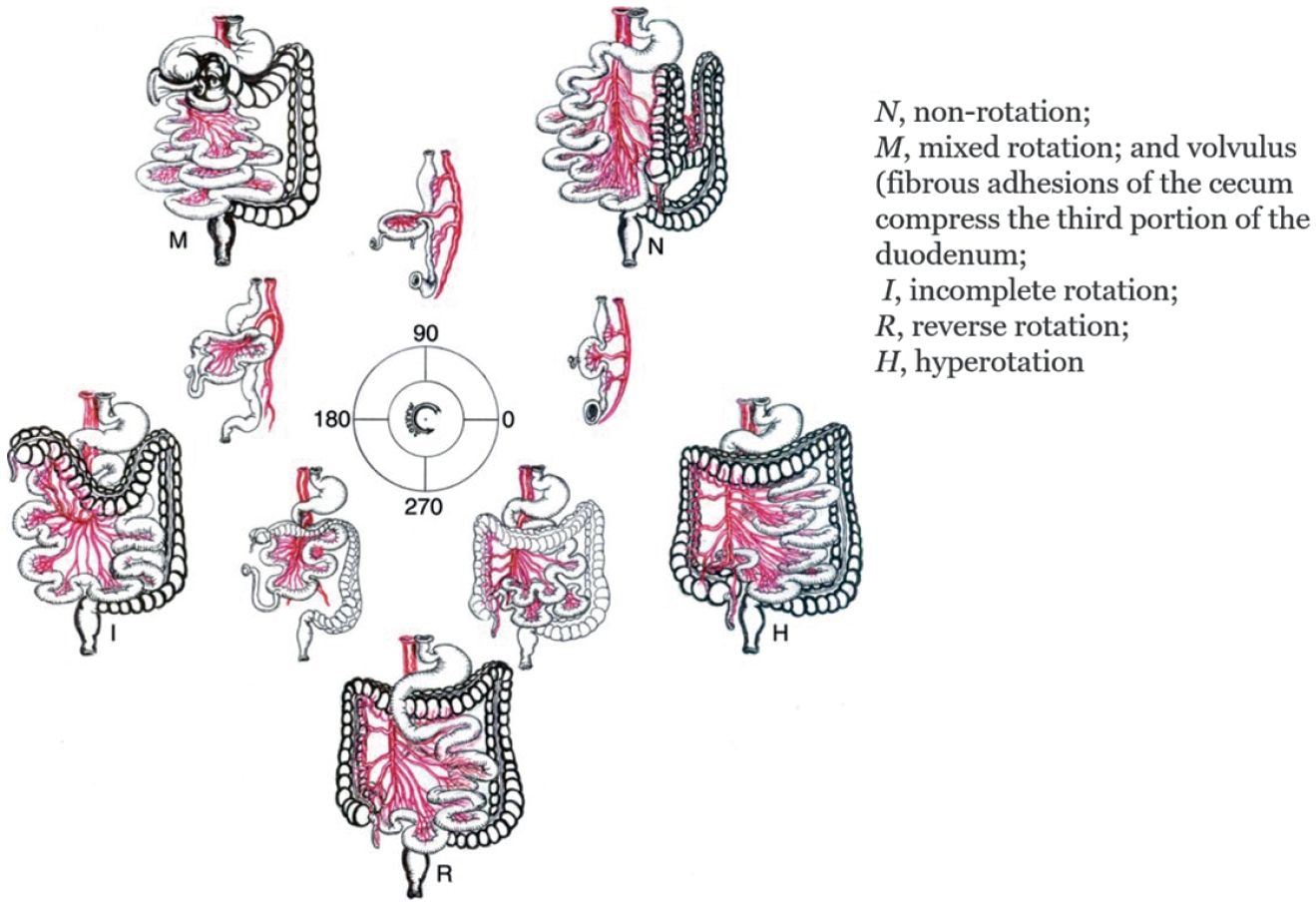
To report the findings of a perception survey on intestinal malrotation conducted by the Korean Association of Pediatric Surgeons (KAPS) in 2021.
Methods
The perceptions on intestinal malrotation regarding clinical decision making of the KAPS members were collected through web-based survey.
Results
A total of 22 surgeons were answered for this study. The results were presented and discussed at the 37th annual meeting of KAPS, which was held in Seoul on June 18, 2021.
Conclusion
This study provides the clinical decisions of the KAPS members on the intestinal malrotation. The study is expected to be an important reference for improving pediatric surgeons’ understanding and treatment of intestinal malrotation.
  • 28 View
  • 2 Download
[English]
A Comparative Study of Three National Surveys on Biliary Atresia by the Korean Association of Pediatric Surgeons
Yeon Jun Jeong, Dayoung Ko, Hyunhee Kwon, Ki Hoon Kim, Dae Yeon Kim, Soo-Hong Kim, Wontae Kim, Hae-Young Kim, Hyun Young Kim, Seong Chul Kim, Younghyun Na, Jung-Man Namgoong, So Hyun Nam, Junbeom Park, Jinyoung Park, Tae-Jun Park, Jeong-Meen Seo, Ji-Young Sul, Joonhyuk Son, Hyun Beak Shin, Joohyun Sim, Soo Min Ahn, Hee Beom Yang, Jung-Tak Oh, Chaeyoun Oh, Joong Kee Youn, Sanghoon Lee, Ju Yeon Lee, Kyong Ihn, Hye Kyung Chang, Eunyoung Jung, Jae Hee Chung, Yu Jeong Cho, Yun Mee Choe, Soo Jin Na Choi, Seok Joo Han, In Geol Ho, Ji-Won Han
Adv Pediatr Surg 2025;31(2):47-58.   Published online July 16, 2025
DOI: https://doi.org/10.13029/aps.2025.31.2.47
Purpose
Biliary atresia (BA) is a rare but progressive cholangiopathy and the leading cause of pediatric liver transplantation worldwide. The Korean Association of Pediatric Surgeons (KAPS) has conducted three national surveys (2001, 2011, and 2023) to assess long-term trends in the diagnosis, treatment, and outcomes of BA. This study provides a comparative analysis of the 2nd and 3rd national surveys, with reference to selected findings from the 1st survey.
Methods
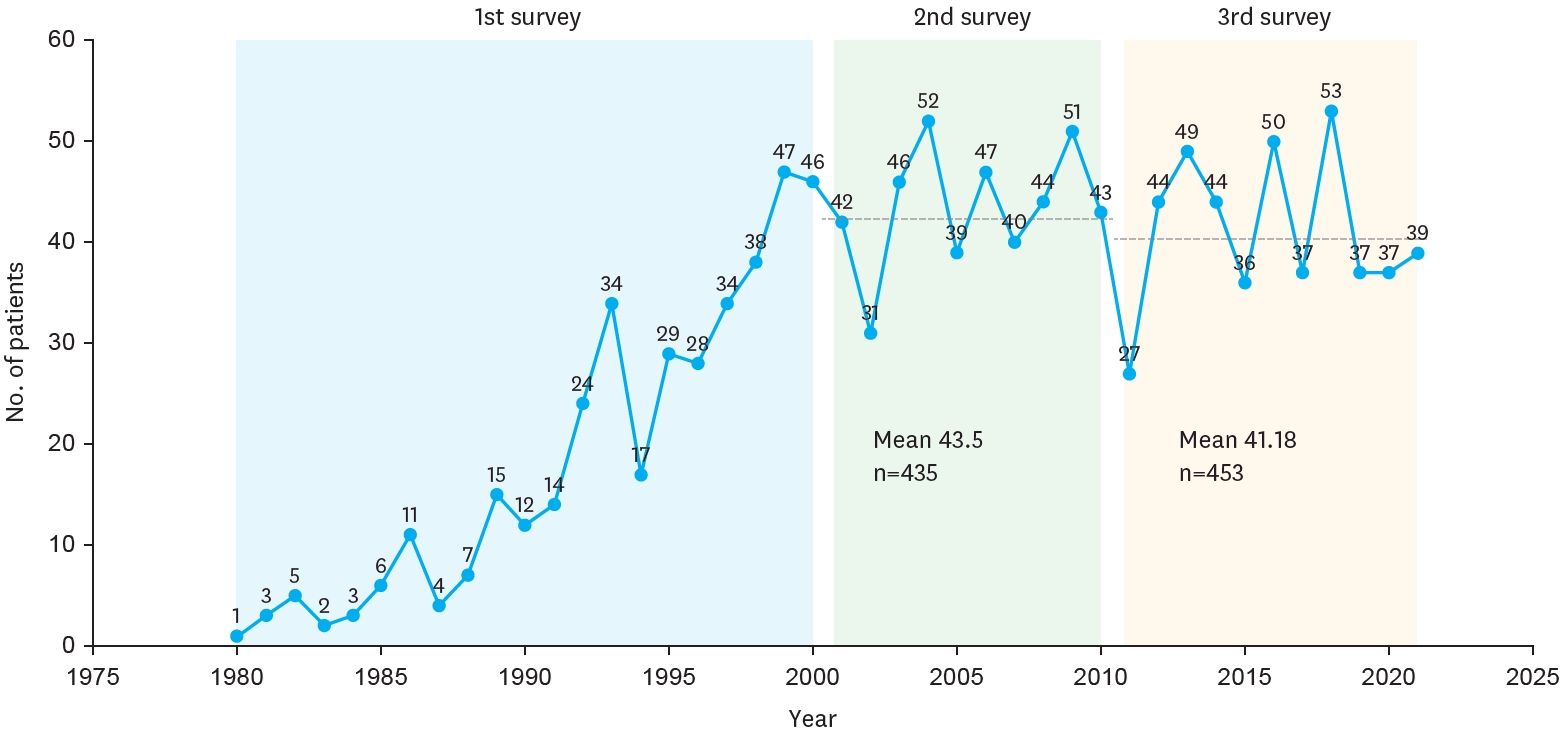
This study included 453 patients from the 3rd national survey (2011–2021) and 435 patients from the 2nd survey (2001–2010), all of whom underwent Kasai portoenterostomy. Data were collected via electronic case report forms from pediatric surgical centers nationwide. Comparisons were made regarding demographics, clinical features, diagnostic patterns, operative details, follow-up outcomes, and survival. Kaplan–Meier analysis was used to evaluate long-term survival.
Results
The mean number of BA patients per year remained stable between surveys (43.5 in the 2nd, 41.18 in the 3rd), though centralization of care increased, with 61.5% of cases managed by two major institutions in the 3rd survey. The median age at surgery decreased, and the use of preoperative imaging (especially magnetic resonance cholangiopancreatography) increased. The 10-year native liver survival rate declined from 59.8% to 53.7%, while overall 10-year survival improved slightly (92.9% to 93.2%). Postoperative complications, such as cholangitis and liver failure, persisted but were better categorized. The 3rd survey also reported improved mortality (4.9%) and reduced follow-up loss (11.5%) compared to the 2nd survey.
Conclusion
While overall survival after Kasai operation has remained high and even improved, native liver survival has slightly declined. The findings reflect earlier diagnosis, more consistent diagnostic imaging, and increasing centralization of care. These trends underscore the importance of long-term nationwide data collection in guiding future strategies for BA management in Korea.
  • 35 View
  • 4 Download
[English]
Comparative Analysis of National Surveys of Intestinal Atresia: A Retrospective Study by the Korean Association of Pediatric Surgeons
Jinyoung Park, Dayoung Ko, Eun-jung Koo, Hyunhee Kwon, Ki Hoon Kim, Dae Yeon Kim, Seong Chul Kim, Soo-Hong Kim, Wontae Kim, HaeYoung Kim, Hyun-Young Kim, So Hyun Nam, Jung-Man Namgoong, Junbeom Park, Taejin Park, Min-Jung Bang, Jeong-Meen Seo, Ji-Young Sul, Joonhyuk Son, Joohyun Sim, Soo Min Ahn, Hee-Beom Yang, Jung-Tak Oh, Chaeyoun Oh, Joong Kee Youn, Sanghoon Lee, Ju Yeon Lee, Kyong Ihn, Hye Kyung Chang, Yeon Jun Jeong, Eunyoung Jung, Jae Hee Chung, Min Jeong Cho, Yun-Mee Choe, Seok Joo Han, In Geol Ho, Jeong Hong
Adv Pediatr Surg 2025;31(1):8-15.   Published online May 28, 2025
DOI: https://doi.org/10.13029/aps.2025.31.1.8
Purpose
This study aims to investigate and compare the incidence, demographic characteristics, clinical manifestations, preoperative diagnostic methods, anatomical classifications, associated anomalies, operative treatments, and postoperative outcomes of patients with intestinal atresia treated by the members of the Korean Association of Pediatric Surgeons (KAPS) through three nationwide surveys.
Methods
KAPS conducted 3 national surveys in 1998, 2010, and 2024 to examine the patients diagnosed with intestinal atresia. In preparation for the survey, we developed a customized case registration form to obtain data on patient sex, birth weight, gestational age, clinical manifestations, preoperative diagnostic methods, anatomical types, associated anomalies, operative treatments, and postoperative outcomes. Authorized KAPS members completed the case registration form.
Results
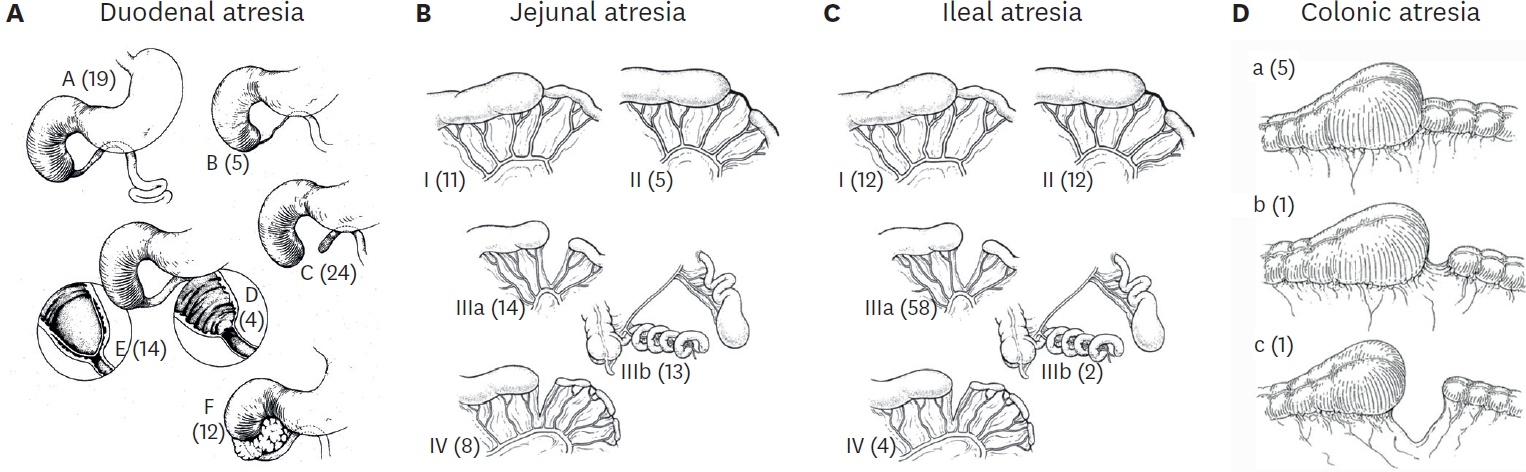
The first, second, and third national surveys included 218, 222, and 236 individuals diagnosed with intestinal atresia, respectively. The male-to-female ratios were 1.5:1, 1.1:1, and 1.1:1, respectively. The first, second, and third national surveys revealed that 34.3%, 43.3%, and 53.4% of patients were born before 37 weeks of gestation, respectively. Additionally, 28.7%, 32.0%, and 40.7% of patients had a birth weight under 2,500 g. In the third national survey, duodenoduodenostomy was the most common procedure, performed in 70 out of 82 patients diagnosed with duodenal atresia. Resection and anastomosis were the main surgical procedures conducted in 47 out of 54 cases of jejunal atresia and 74 out of 92 cases of ileal atresia. The mortality rates in the first, second, and third national surveys were 13.8%, 3.6%, and 1.3% respectively, with the lowest rate observed in the third national survey.
Conclusion
These national surveys offer valuable insights into the current state of intestinal atresia, including specific surgical interventions and postoperative outcomes in South Korea. For pediatric surgeons aiming to enhance their understanding of intestinal atresia and its treatment options, these surveys could be an indispensable resource and guide.
  • 28 View
  • 2 Download
[English]
Variation in Long-Term Care of Pediatric Surgery Patients: A Survey of Pediatric Surgeons in Korea
Wontae Kim, Sungjoo Park, Jeong-Meen Seo, Sanghoon Lee
Adv Pediatr Surg 2025;31(1):1-7.   Published online May 28, 2025
DOI: https://doi.org/10.13029/aps.2025.31.1.1
Purpose
This study aimed to evaluate postoperative outpatient follow-up practices among pediatric surgeons in Korea for five common congenital diseases: esophageal atresia with tracheoesophageal fistula (EA/TEF), anorectal malformation (ARM), Hirschsprung’s disease (HSCR), choledochal cyst (CC), and inguinal hernia (IH).
Methods
A web-based survey consisting of 43 questions was distributed to members of the Korean Association of Pediatric Surgeons. The survey assessed the timing, frequency, and duration of outpatient follow-up, as well as disease-specific practices.
Results
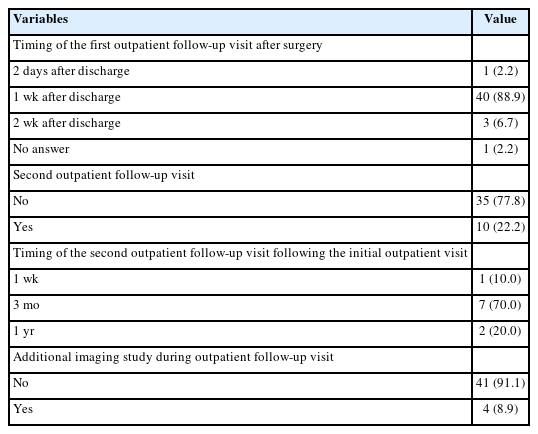
Of 154 invited surgeons, 45 (29.2%) responded. Most scheduled the first follow-up visit within one week after discharge. During the first postoperative year, follow-up visits were commonly held every three months, followed by six months or annual intervals. Most surgeons concluded follow-up before age 18; however, 15.6%–37.8% reported continuing follow-up into adulthood depending on the disease. Variation was observed in disease-specific practices: 44.4% routinely performed contrast studies for EA/TEF follow-up; sizes #14–15 Hegar dilators were most used in ARM; only 6.7% performed routine rectal irrigation in HSCR. For CC, 88.9% checked both blood tests and ultrasonography. Most IH patients received only one follow-up visit.
Conclusion
While early postoperative follow-up practices among pediatric surgeons in Korea appear relatively consistent, wide variation exists in long-term strategies and disease-specific protocols. This reflects the tendency to rely on individual clinical judgment and highlights the need for standardized, national consensus.
  • 60 View
  • 7 Download
[English]
Comparative Analysis of Two National Surveys on Esophageal Atresia With or Without Tracheoesophageal Fistula: A Retrospective Study by the Korean Association of Pediatric Surgeons
Jinyoung Park, Dae Yeon Kim, Seong Chul Kim, Hyun-Young Kim, So Hyun Nam, Jeong-Meen Seo, Jung-Tak Oh, Myung-Duk Lee, Suk-Koo Lee, Soo Min Ahn, Hye Kyung Chang, Sung Eun Jung, Yeon Jun Jeong, Eunyoung Jung, Jae Hee Chung, Yong Hoon Cho, Soon Ok Choi, Seung Hoon Choi, Yun Mee Choe, Seok Joo Han, Jeong Hong, Nam-Hyuk Lee
Adv Pediatr Surg 2024;30(1):1-8.   Published online May 31, 2024
DOI: https://doi.org/10.13029/aps.2024.30.1.1
Purpose
The Korean Association of Pediatric Surgeons (KAPS) conducts annual nationwide surveys on various aspects of pediatric surgical diseases, with the results being discussed during KAPS’s annual spring meetings.
Methods
KAPS conducted two national surveys, in 1995 and 2016, to investigate esophageal atresia (EA) with or without tracheoesophageal fistula (TEF). The authors analyzed data from these surveys to identify differences or changes in the annual occurrence, demographic characteristics, clinical presentation, preoperative diagnostic methods, anatomical type, associated anomalies, surgical treatment, and postoperative outcomes among patients with EA/TEF treated by KAPS members.
Results
The first and second national surveys included 148 and 211 patients with EA/TEF, respectively. Excessive salivation was the most prevalent clinical symptom in both surveys. Type C was the most common form of EA/TEF in both surveys. The first survey included 126 patients, all of whom underwent open surgery. In the second survey, 152 (78.4%) of 194 patients underwent open surgery, while 34 (17.5%) underwent thoracoscopic surgery. Primary esophageal repair was performed on 96 (76.2%) of 126 patients in the first survey and on 160 (82.5%) of 194 patients in the second survey. Anastomotic strictures developed in 21.4% and 32.5% of patients, anastomotic leakage in 22.2% and 10.3%, recurrent fistula in 2.4% and 4.2% during the first and second surveys, respectively. The respective survival rates for group A were 90.2% and 98.3% in the first and second surveys. For group B, the rates were 73.9% and 98.1%, and for group C, they were 34.5% and 68.1%, respectively, according to the Waterston classifications.
Conclusion
These nationwide surveys provide comprehensive information on the status, detailed treatment, and outcomes for Korean pediatric patients with EA/TEF. They are anticipated to be an invaluable resource and guide for pediatric surgeons seeking to expand their knowledge on EA/TEF and its treatment options.
  • 55 View
  • 3 Download
[English]
Sacrococcygeal Teratoma: A Survey by the Korean Association of Pediatric Surgeons in 2018
Jung-Tak Oh, Hye Kyung Chang, Min Jeong Cho, Yong Hoon Cho, Soo Jin Na Choi, Yoon Mi Choi, Jae Hee Chung, Sang Young Chung, Jeong Hong, Seok Joo Han, Yeon Jun Jeong, Eunyoung Jung, Kyuhwan Jung, Dae Youn Kim, Hae-Young Kim, Hyun-Young Kim, Ki Hoon Kim, Sang Youn Kim, Seong Chul Kim, Seong Min Kim, Soo-Hong Kim, Jong-In Lee, Myung-Duk Lee, Nam-Hyuk Lee, Suk-Koo Lee, So Hyun Nam, Jin Young Park, Kwi-Won Park, Tae-Jin Park, Jeong-Meen Seo, Jae Ho Shin, Jiyoung Sul
Adv Pediatr Surg 2019;25(2):35-43.   Published online December 18, 2019
DOI: https://doi.org/10.13029/aps.2019.25.2.35
Purpose

The Korean Association of Pediatric Surgeons (KAPS) performed a nationwide survey on sacrococcygeal teratoma in 2018.

Methods

The authors reviewed and analyzed the clinical data of patients who had been treated for sacrococcygeal teratoma by KAPS members from 2008 to 2017.

Results

A total of 189 patients from 18 institutes were registered for the study, which was the first national survey of this disease dealing with a large number of patients in Korea. The results were discussed at the 34th annual meeting of KAPS, which was held in Jeonju on June 21–22, 2018.

Conclusions

We believe that this study could be utilized as a guideline for the treatment of sacrococcygeal teratoma to diminish pediatric surgeons' difficulties in treating this disease and thus lead to better outcomes.

  • 10 View
  • 0 Download

Review Articles

[English]
Neonate Congenital Bochdalek Hernia: A National Survey of Its Members by Korean Association of Pediatric Surgeons
D Y Kim, S C Kim, S H Kim, H Y Kim, H Y Kim, S H Nam, K W Park, J B Park, J Y Park, Y J Boo, J M Seo, S M Ahn, J T Oh, S K Lee, S C Lee, E Y Jang, H K Jang, S E Jung, S M Jung, Y J Jung, E Y Jung, M J Cho, S O Choi, S J Han, Y J Hong, J Hong
J Korean Assoc Pediatr Surg 2016;22(1):6-9.   Published online June 30, 2016
DOI: https://doi.org/10.13029/jkaps.2016.22.1.6

This is a survey on congenital posterolateral diaphragmatic hernia, conducted by Korean Association of Pediatric Surgeons (KAPS). A registration form for each patient during the 5-year period between 2010 and 2014 and a questionnaire were sent to each member. Twenty-six members in 16 institutions returned completed forms. Total patients were 219. Prenatal diagnoses were done in 181 cases (82.6%). Preoperative mortality was 11.4%. Minimal invasive surgery was done in 61 cases (31.8%). Risk factors related with death were Apgar score, oxygenation index, preoperative pH and bicarbonate, O2 saturation, the presence of hernia sac, and the size of defect. The neonatal survival and 1-year survival of total patients were 77.6% and 75.3%.

  • 8 View
  • 0 Download
[English]
Newborns Surgery with Congenital Anomalies: A National Survey of Its Members by Korean Association of Pediatric Surgeons
D Y Kim, S C Kim, S H Kim, H Y Kim, H Y Kim, S H Nam, K W Park, J B Park, J Y Park, T J Park, J M Seo, J Y Seol, J H Shin, J T Oh, M D Lee, S K Lee, S C Lee, E Y Jang, H K Jang, S Y Jung, S E Jung, S M Jung, Y J Jung, E Y Jung, M J Cho, S J N Choi, S O Choi, S H Choi, Y M Choi, S J Han, T K Heo
J Korean Assoc Pediatr Surg 2016;22(1):1-5.   Published online June 30, 2016
DOI: https://doi.org/10.13029/jkaps.2016.22.1.1

National survey for newborns surgery with congenital anomalies by Korean Association of Pediatric Surgeons (KAPS) was done. A questionnaire was sent to all members of the KAPS on March 2014. The current survey is to review three years status of the newborn surgery from 2012 to 2013. Thirty-four members (27.9%) took part in the survey that included data for the diagnosis, number and procedures of neonatal surgical cases. The result was discussed at the Topic Discussion section of the 30th Annual Congress of KAPS, 2014.

  • 11 View
  • 0 Download

Original Articles

[English]
Minimal Invasive Surgery: A National Survey of Its Members by the Korean Association of Pediatric Surgeons
DY Kim, IS Kim, HY Kim, SH Nam, KW Park, WH Park, YJ Park, JH Park, JY Park, JS Park, JY Park, YJ Boo, JM Seo, JY Seol, JT Oh, NH Lee Lee, JH Jang, KH Jung, SY Jung, SE Jung, SM Jung, EY Jung, JH Jung, MJ Cho, KJ Choi, SJN Choi, SO Choi, SH Choi, YM Choi, J Hong
J Korean Assoc Pediatr Surg 2014;20(1):1-6.   Published online June 30, 2014
DOI: https://doi.org/10.13029/jkaps.2014.20.1.1

Minimal invasive surgery (MIS) has rapidly gained acceptance for the management of a wide variety of pediatric diseases. A questionnaire was sent to all members of the Korean Association of Pediatric Surgeons. Thirty one members (25.4%) took part in the survey that included data for the year 2012: demographic details, opinion regarding minimal invasive surgery and robotic surgery, spectrum of minimally invasive operations, and quantity of procedures. 48.4% of the respondents had more than 10 years experience, 35.5% less than 10 years experience, and 16.1 % had no experience. The respondents of the recommend MIS and perform MIS for surgical procedures are as follow; inguinal hernia (61.3%), simple appendicitis (87.1%), complicated appendicitis (80.6%), reduction of intussusceptions (83.9%), pyloromyotomy (90.3%), fundoplication (96.8%), biopsy and corrective surgery of Hirschsprung's disease (93.5%/90.3%), imperforate anus (77.4%), congenital diaphragmatic hernia (80.6%), and esophageal atresia (74.2%). The MIS procedures with more than 70% were lung resection (100%), cholecystectomy (100%), appendectomy (96.2%), ovarian torsion (86.7%), fundoplication (86.8%), hiatal hernia repair (82.6%), and splenectomy (71.4%). The MIS procedures with less than 30% were congenial diaphragmatic hernia reapir (29.6%), esophageal atresia (26.2%), correction of malroatation (24.4%), inguinal hernia repair (11.4%), anorectal malformation (6.8%), Kasai operation (3.6%).

  • 11 View
  • 0 Download
[English]
Choledochal Cyst in Korea: A Survey by the Korean Association of Pediatric Surgeons
KJ Choi, DY Kim, SY Kim, SC Kim, SK Kim, WK Kim, IK Kim, JE Kim, JC Kim, HY Kim, HJ Kim, KW Park, YS Park, WH Park, JY Park, HK Paek, JM Seo, YT Song, SM Oh, SY Yoo, DS Lee Lee, SK Lee, SC Lee, TH Lee, SY Chung, SE Chung, US Chung, PM Jung, MH Cho, DH Joo, JS Joo, SO Choi, SH Choi, SJ Han, YS Huh, C Hong, EH Whang
J Korean Assoc Pediatr Surg 2003;9(1):45-51.   Published online June 30, 2003
DOI: https://doi.org/10.13029/jkaps.2003.9.1.45

A nationwide survey on Choledochal cyst was undertaken among 39 members of the Korean Association of Pediatric Surgeons. The members were required to complete a questionnaire and the case registration form for each patient during the five-year period of 1997 to 2001. Three hundred and forty eight patients were registered from 32 institutions. The average number of patients per surgeon was one to two every year. The male to female ratio was 1: 3.4. The age of patients on diagnosis was 49.0±44.4 months. The geographic distribution was 34.8% in Seoul and Kyoungki-do, 33.3% in Kyoungsang-do, 17.9% in Cholla-do, and 8.5% in Choongchung-do, in order of frequency. The three common clinical presentations were abdominal pain (63.8%), vomiting (35.3%), and jaundice (29.1%). Only seven patients (2%) presented with classic triad, and 25 patients were diagnosed by antenatal ultrasonographic examination. According to the Todani classification, 238 patients (71.3%) were type I, 3 (0.9%) type II, and 93 (27.8%) type IV. At the time of the operation, three important associated conditions were choledocholithiasis in 45 patients (15.1%), liver fibrosis (Grade 1-4) in 35, and previous operative procedure for biliary diseases in 10. Associated anomalies were observed in 13 patients (3.8%). Three hundred thirty nine (98.8%) of 343 lesions were treated by cyst excision and Roux-Y hepaticojejunostomy. One hundred seventy-six patients had an anomalous arrangement of the pancreatobiliary ductal system: APBD was not in 92 patients, biliary duct joined to the pancreatic duct in 51, and pancreatic duct joined to the biliary duct in 26. There were 8.5% early, and 7.7% late phase operative complications. The major complications were bleeding, anastomotic leakage, and acute pancreatitis. The combination of acute abdomen and choledochal cyst may suggest spontaneous rupture. Because of the development of late intrahepatic bile duct stones, long-term follow-up after cyst excision and hepaticojejunostomy is required. The optimal time of surgical intervention should also be considered in the situation of routine use of antenatal ultrasonographic examination. This is the first review of the choledochal cyst in Korea and provides baseline data for future comparisons.

  • 5 View
  • 0 Download
[English]
Biliary Atresia in Korea: A Survey by the Korean Association of Pediatric Surgeons
K J Choi, S C Kim, S K Kim, W K Kim, I K Kim, J E Kim, J C Kim, H Y Kim, H H Kim, K W Park, W H Park, Y T Song, S M Oh, D S Lee, S K Lee, S C Lee, S Y Jhung, S E Jhung, P M Jung, S O Choi, S H Choi, S J Han, Y S Huh, C Hong, E H Hwhang
J Korean Assoc Pediatr Surg 2002;8(2):143-155.   Published online December 31, 2002
DOI: https://doi.org/10.13029/jkaps.2002.8.2.143

A survey on biliary atresia was made among 26 members of the Korean Association of Pediatric Surgeons. The members were required to complete a questionnaire and a case registration form for each patient during the twentyone-year period of 1980-2000. Three hundred and eighty patients were registered from 18 institutions. The average number of patients per surgeon was one to two every year. The male to female ratio was 1 : 1.3. The age of patients on diagnosis with biliary atresia was on average 65.4 ±36.2 days old. The national distribution was 32.8% in Seoul, 25.3% in Gyoungki-Do, 21.6% in Gyoungsang-Do, 9.27% in Choongchung-Do, etc. in order. The most common clinical presentation was jaundice (98.4%) and change of stool color (86.2%) was second. Two hundred eighty (74.7%) of 375 patients were operated by 80 days of age. Three hundred thirty six (91.9%) of 366 patients were operated on by the original Kasai procedure, and 305 (84.3%) of 362 patients were observed by bile-drainage postoperatively. The overall postoperative complication rate was 18.5% and the overall postoperative mortality rate was 6.8%. The associated anomalies were observed in 72 cases (22.5%). One hundred ninty five (64.7%) of 302 patients have been alive in follow-up and 49 (25.1%) have survived over 5 years without problem after operation. Ascending cholangitis, varices and ascites affected survival significantly, and the important long-term prognostic factor was the occurrence of complications.

  • 6 View
  • 0 Download
[English]
Current Status (1999) of Neonatal Surgery in Korea: Survey among the members of Korean Association of Pediatric Surgeons
W K Kim, S Y Kim, S K Kim, I K Kim, J C Kim, H H Kim, K W Park, W H Park, Y T Song, S M Oh, Y S Yoo, D S Lee, M D Lee, S K Lee, S C Lee, J M Seo, S Y Chung, S E Jung, U S Chung, P M Jung, M H Cho, K J Choi, S O Choi, S J Han, Y S Huh, J Hong, E H Hwang
J Korean Assoc Pediatr Surg 2001;7(1):46-53.   Published online June 30, 2001
DOI: https://doi.org/10.13029/jkaps.2001.7.1.46

To understand the current status of neonatal surgery in Korea, a survey was made among the 36 members of the Korean Association of Pediatric Surgeons. The response rate was 75% (26 surgeons in 20 hospitals). Five hundred fifty three neonatal surgical patients treated in 1999 were analyzed. Regional numbers of patients were closely related to the regional population in most areas. Ano-rectal malformations (17%), pyloric stenosis (16%), Hirschsprung's disease (13%), atresia/stenosis of the gut (11%), esophageal atresia (8%) were the most common anomalies treated. The majority of operations were done within the first week of life. Seventy one per cent of cases were major life threatening or so-called neonatal index cases. Over-all mortality was 8 per cent. Higher mortality was observed in patients with diaphragmatic hernia (26%), gastro-intestinal perforation (18%), NEC (18%), and esophageal atresia(14%). Higher mortality was observed in patients with extremely low birth weight (33%) and low birth weight (18%). Associated anomalies were observed in 20%. Prenatal ultrasound was performed in 36 per cent with sensitivity of 20%. Result of this study was compared to the previous report (1994) and that of Japan (1998).

  • 6 View
  • 0 Download
[English]
Current Status of Pediatric Surgical Practice in Korea: a Survey among the Members of Korean Association of Pediatric Surgeons
WK Kim, SY Kim, SK Kim, IK Kim, JE Kim, CS Kim, HH Kim, KW Park, YS Park, WH Park, JS Park, YT Song, JW Yang, SM Oh, OS Lee, MO Lee, SK Lee, SC Lee, SI Chang, SE Jung, PM Jung, KJ Choi, SO Choi, YS Huh, EH Hwang
J Korean Assoc Pediatr Surg 1997;3(1):61-67.   Published online June 30, 1997
DOI: https://doi.org/10.13029/jkaps.1997.3.1.61

To understand the current status of pediatric surgical practice of the members of the Korean Association of Pediatric Sutgeons, a survey of the practice of the 31 members in both 1994 and 1995. Twenty five members(80%) representing 20 hospitals responded. An average of four hundred and seventy four cases pediatric surgical operations were performed at individual institution in 1995 with 40 newborn cases. Eighteen members(72%) ate currently working at university hospital. Fourteen institutions(70%) are currently classified as tertiary by the health insurance agency. The majority(l5 to 60%) of members are working in the metropolitan Seoul area, while five in Taegu area. Sixteen members reported having the title of department head/director. Four members reported occasional non-pediatric surgical practice. Nine members out of 20 reported having independent pediatric surgical out-patient clinic before the establishment of the association( 1985). Eight out of 15 members reported being appointed chief of pediatric surgery before 1985. In 20 institutions, 34 full time physicians(27 members, reportedly) are working in pediatric surgery. In regarding to pediatric surgical training, 16 members(64%) received an average of 16 months of training abroad, 5 members trained at home and abroad, and 4 from only at home. There are no differences in length of training periods in these groups. TWenty one members received their basic pediatric surgical training before 1985, the year of inauguration of the association. Twelve members received post-pediatric surgery refresher courses averaging 11 months' duration, after 2-11 years. Thirteen participants of this study belongs to the founding members of the association.

  • 7 View
  • 0 Download
[English]
Diagnosis and Treatment of Hirschsprung's Disease in Korea: Current Status of 1992
SY Yoo, SY Kim, WK Kim, IK Kim, JE Kim, KW Park, WH Park, JS Park, YT Song, SM Oh, OS Lee Lee, SC Lee, SI Chang, SY Chung, ES Chung, PM Jung, JS Joo, KJ Choi, SO Choi, SH Choi, YS Huh, EH Hwang
J Korean Assoc Pediatr Surg 1996;2(1):33-41.   Published online June 30, 1996
DOI: https://doi.org/10.13029/jkaps.1996.2.1.33

This report present the result of the national survey of pediatric surgeons' preferences on diagnosis and treatment of Hirschsprung's disease(HD) carried out in 1993. The questionnaires were sent to twenty-seven members of the Korean Association of Pediatric Surgeons (KAPS) working in twenty-four institutions. The questionnaires were designed to determine the individual surgeon's preference for the methods of diagnosis and treatment of the disease. Twenty-three pediatric surgeons from twenty institutions returned completed forms. The total number of patients diagnosed with HD in 1992 was 190 in this group. The estimated incidence of HD was 1/3,900. The most important symptom was delayed meconium passing and the most preferred diagnostic procedure was barium study. Anorectal manometric examination was carried out by 13 pediatric surgeons and 19 confirmed the diagnosis before operation by rectal biopsy, 12 with full-thickness biopsy and 7 with suction. Frozen section biopsy during operation was done by 22 surgeons. Eight surgeons did one stage operation if the age of the patient is suitable. Definitive operation was usually done at the age of 6 to 11 months. The most preferred operation was Duhamel procedure done by 19. Enterocolitis was the most serious complication of HD. Most of patients had normal continence within 6 to 12 months after operation. The follow-up period was less than 6 years in 16 surgeons. The results were presented at the 9th annual meeting of KAPS in June of 1993. This is the first national survey of HD and it can provide guidelines of diagnosis and treatment of Hirschprung's disease even though it is not a detailed study of patient data.

  • 5 View
  • 0 Download
[English]
Current Status(1994) of Neonatal Surgery in Korea: Survey among the members of Korean Association of Pediatric Surgeons
WK Kim, SY Kim, SK Kim, IK Kim, JC Kim, KW Park, YS Park, WH Park, JS Park, YT Song, SM Oh, OS Lee Lee, SC Lee, SI Chang, ES Chung, PM Jung, JS Joe, SO Choi, YS Huh, EH Hwang
J Korean Assoc Pediatr Surg 1996;2(1):26-32.   Published online June 30, 1996
DOI: https://doi.org/10.13029/jkaps.1996.2.1.26

To understand the current status of neonatal surgery in Korea, a suvey was made among the 27 members of Korean Association of Pediatric Surgeons. Response rate among surgeons was 78 perecnt, eighteen hospitals participated in this study. Five hundred and three cases of neonatal surgical patients were analyzed. In Korea, about 50% of cases were treated at the hospital in the capital city area. Regional number of patients were closely related to the regional population. Imperforate anus(19%), atresia/stenosis of gut(12%), and Hirschsprung's diseases(12%) were sitting at the top in the list. Majority of operation was done within the first week of life, especially during the first 24 hour period. Eighty per cent was major or so called index cases. Mortality in so-called index cases was 17%. High mortality was observed in patients with diaphragmatic hernia(47%), gastrointestinal perforation(65%) and esophageal atresia(28%). Low birth weight babies showed higher mortality in gastro -intestinal perforation, esophageal atresia and abdominal wall defect. These were compared to 1993 survey of Japanese Society of Pediatric Surgeons.

  • 5 View
  • 0 Download
[English]
Esophageal Atresia and Tracheoesophageal Fistula in Korea: A National Survery of Its Members by the Korean Association of Pediatric Surgeons
WH Park, SI Kwon, SC Kim, SK Kim, WK Kim, IK Kim, JE Kim, HH Kim, KW Park, YS Park, YT Song, JW Yang, SM Oh, SY Yoo, DS Lee Lee, SC Lee, SK Lee, TS Lee, SI Chang, SY Chun, ES Chung, SY Chung, SE Chung, PM Chung, MH Cho, JS Joo, SO Choi, SH Choi, YS Huh, C Hong
J Korean Assoc Pediatr Surg 1995;1(2):149-161.   Published online December 31, 1995
DOI: https://doi.org/10.13029/jkaps.1995.1.2.149

The first national survey on esophageal atresia and tracheoesophageal fistula was conducted to access the current status of its incidence. clinical manifestation, preoperative diagnosis and management, type of its anomaly, associated anomalies, and surgical results and course. The 43 members of the Korea Association of Pediatric Surgeons received questionnaires and registration forms to be filled out on each patient who were born during the three years from January I, 1992 through Decestricurember 31, 1994. Questionnaires composed of six broad areas which include 1) preoperative diagnosis and management, 2) surgical technic, 3) long gap, 4) postoperative management, and 5) complications and courses. A total of 148 cases was returned by 28 members working at 23 institutions and 27 members returped questionnaires. We obtained the following results by analysis of the 148 cases of tracheoesophageal anomalies. The incidence of tracheoesophageal anomaly was about 1/10,000-11,000 in 1994, which is one third of that of anorectal malformations in Korea and the distribution of the patients was almost proportionate to the size of each province. Both sexes are about equally affected. Majority of the members make diagnosis of tracheoesophageal anomaly by taking a simple infantogram with a radiopaque tube in upper pouch and a little under half(46%) prefers to perform echocardiography as a part of preoperative management to identify congenital heart disease and lateralize the aorta.

Esophageal atresia with distal TEF(87.50/0) was by far the most common and threre were pure esopahgeal atresia(5.6%), H-type TEF(2.l%), and so on. About half(49%) of the patients had one or more associated anomalies in addition to tracheoesophageal anomalies. Congenital heart disease was associated in 46 cases(31 %), anorectral malfomations in 19 cases(13%), musculoskeletal anomalies in 15 cases(10%), genitourinary anomalies in 10 cases(7%) and gastrointestinal anomalies in 7 cases(5%). Postoperatively, parenteral nutrition and assisted ventilation were given in 66% and 52% of patients respectively. Ninety three(74%) of 126 cases who underwent surgical procedure, experienced one or more complications such as respiratory complication (65%), leak(22%), stricture(21%) and so on. The survival rates related to the Waterston risk categories were 90.2% in grpup A, 71.4-75% in B1, B2, and C groups, and 28% in group C2 and the overall survival rate was 71.4%. Thirty six(28.6%) of 126 cases died of pneumonia/sepsis(12 cases), respiratory failure(l2 cases), and congenital heart disease(4 cases). With short term follow-up, 69% of patients have been excellent whereas remainders of the cases have suffered from some sort of morbidity related to gastroesophageal reflux, recurrent respiratory infection, and esophageal stricure.

  • 6 View
  • 0 Download
[English]
A Comparative Study of Two National Surveys of Choledochal Cysts in the Korean Association of Pediatric Surgeons
Park, Jinyoung , Kim, Dae Yeon , Kim, Seong Chul , Kim, Hyun-Young , Nam, So Hyun , Seo, Jeong-Meen , Oh, Jung-Tak , Lee, Myung-Duk , Lee, Suk-Koo , Ahn, Soo Min , Chang, Hye Kyung , Jung, Sung Eun , Jeong, Yeon Jun , Jung, Eunyoung , Chung, Jae Hee , Cho, Yong Hoon , Choi, Soon Ok , Choi, Seung Hoon , Choe, Yun Mee , Han, Seok Joo , Hong, Jeong , Lee, Nam-Hyuk
Adv Pediatr Surg 2023;29(2):49-57.
DOI: https://doi.org/10.13029/aps.2023.29.2.49
Purpose
The Korean Association of Pediatric Surgeons (KAPS) has conducted annual national surveys, each year addressing a different topic regarding pediatric surgical diseases, and the data of these surveys are discussed at each respective annual spring meeting of KAPS.
Methods
In 2002 and 2017, KAPS conducted two national surveys for choledochal cysts. The authors reviewed the data from the national surveys and analyzed the differences or changes in demographic characteristics, clinical findings, diagnostic methods, treatment, and outcomes of pediatric patients with choledochal cysts who had been treated by KAPS members.
Results
A total of 348 and 241 patients with choledochal cysts were enrolled in the first and second national surveys, respectively. The male-to-female ratio was 1:3.4 and 1:2.7 in the first and second national surveys, respectively. In both national surveys, abdominal pain was the most common clinical symptom. The most common type of choledochal cyst was type I in 71.3% and 73.9% of patients in the first and second national surveys, respectively. In the first national survey, all 348 patients underwent open surgery. However, in the second national survey of 241 patients, open, laparoscopic, and robotic surgeries were performed in 102 (42.3%), 75 (31.1%), and 56 (23.2%) patients, respectively. Cyst excision with Roux-en-Y hepaticojejunostomy was performed in 339 (98.8%) of 343 patients in the first national survey and 240 (99.6%) of 241 patients in the second national survey.
Conclusion
These national surveys provide current status, general information, and comprehensive treatment and outcomes for pediatric patients with choledochal cysts in Korea. This study could provide significant knowledge and reference for pediatric surgeons seeking to better understand choledochal cysts and treatment options for this disease.
  • 47 View
  • 1 Download
[English]
Index Cases in Pediatric Surgery, 2000: National Survey by the Korean Association of Pediatric Surgeons
Lee, M D , Kim, S Y , Kim, W K , Kim, I K , Kim, S C , Kim, S K , Kim, J E , Kim, J C , Kim, H H , Park, K W , Park, W H , Seo, J M , Song, Y T , Oh, S M , Yoo, S Y , Lee, D S , Lee, S K , Lee, S C , Chung, S Y , Chung, S U , Jung, E S , Jung, P M , Cho, M H , Choi, K J , Choi, S O , Choi, S H , Han, S J , Huh, Y S , Hong, C , Whang, E H
J Korean Assoc Pediatr Surg 2001;7(2):147-156.
DOI: https://doi.org/10.13029/jkaps.2001.7.2.147
Membership qualifications and recognition of the subspecialty training programs by the Korean Association of Pediatric Surgeons (KAPS) have been determined by criteria based on the number of neonatal and total pediatric surgical cases registered, since 1989 (Index cases). The numbers are based on a survey of the 14 founding members of the society by Jung et al. in 1987. The current survey is to review the present status of the index cases from 1997 to 1999 among 36 members of the KAPS. Two surveys were undertaken for this study. In the first survey, cases were collected by the registration form, composed of neonatal (N), important pediatric surgical cases (I), tumor and other similar operations (T) and other common pediatric surgical cases (O). Thirty members responded, and the result was discussed at the Topic Discussion section of the . 15th annual Congress of KSPA, 2000. The second survey analyzed additive data, proposed during discussion at the Congress. Twenty-three members responded. This report is the analysis of the both surveys. The average numbers of the cases/year/surgeon of N, I, T, O and total were 19.5, 51.6, 9.5, 77.1 and 356.5, respectively. The number of index cases (N+I+T)/year/surgeon was 80.8. The ratio of (N+I+T)/total cases was 0.3. Seventeen of 30 members have more than 20 cases of N per year. Twelve members have more than 150 cases, and 13 do more than 100 cases of I per year. Fourteen members have more than 10 cases of T per year. Nineteen and 10 members experienced more than 150 and 100 of index cases (N+I+T) per year. A new list of the index cases and coding system are proposed for the future regular update.
  • 6 View
  • 0 Download
[English]
A Comparative Study of Two National Surveys of Anorectal Malformations in the Korean Association of Pediatric Surgeons
Park, Jinyoung , Kim, Woo Ki , Kim, In Koo , Kim, Jae Eok , Kim, Jae Chun , Kim, Hyun Hak , Kim, Sang Youn , Kim, Dae Yeon , Kim, Seong Chul , Kim, Chong Suk , Kim, Hyun-Young , Nam, So Hyun , Park, Kwi-Won , Park, Woo Hyun , Boo, Yoon Jung , Song, Young Tack , Oh, Soo Myung , Yoo, Soo Young , Lee, Doo Sun , Seo, Jeong-Meen , Oh, Jung-Tak , Lee, Nam-Hyuk , Lee, Myung-Duk , Lee, Suk-Koo , Lee, Seong Cheol , Lee, Jong In , Chang, Soo Il , Chung, Sang Young , Chang, Hye Kyung , Jung, Sung Eun , Jeong, Yeon Jun , Chung, Jae Hee , Chung, Eul Sam , Jung, Poong Man , Cho, Ma Hae , Choi, Kum Ja , Choi, Soon Ok , Choi, Seung Hoon , Choe, Yun Mee , Han, Seok Joo , Huh, Young Soo , Hong, Jeong , Hwang, Eui Ho
Adv Pediatr Surg 2022;28(2):37-46.
DOI: https://doi.org/10.13029/aps.2022.28.2.37
Purpose
Anorectal malformations (ARMs) represent a wide spectrum of anomalies with various presentations and associated anomalies. The management of ARMs is still controversial and various managements for ARMs have been proposed. The aim of this study was to identify the status of ARMs in Korea and to analyze the data regarding classification, treatment and functional outcomes of ARMs among the Korean Association of Pediatric Surgeons (KAPS) members.
Methods
The KAPS has conducted a national survey for ARMs in 1999 and 2015 to analyze the differences and changes in the classification, treatment, and functional outcomes of ARMs.
Results
A total of 295 and 619 ARMs patients were enrolled in the second and third national survey, respectively. The most common type among male and female was the low type in the second national survey and low defects (cutaneous fistula, anal stenosis, membrane) in the third national survey. Most common associated anomalies were genitourinary system in the second national survey and cardiovascular system in the third national survey. Various surgical options including anoplasty, posterior sagittal anorectoplasty (PSARP) and laparoscopic surgery with or without colostomy were performed. Unfortunately, comparison regarding functional outcomes between 2 national surveys was not possible due to the use of different classification and functional assessment criteria.
Conclusion
We suggest making an ARMs registry at a national level so that multicenter functional outcome data can be collected for a better understanding and management of this rare anomaly.
  • 17 View
  • 0 Download
[English]
Lymphangioma: A 2019 Survey Conducted by the Korean Association of Pediatric Surgeons
Oh, Jung-Tak , Ahn, Soo Min , Boo, Yoon-Jung , Chang, Eun Young , Chang, Hye Kyung , Choi, Soo Jin Na , Choi, Yoon Mi , Chung, Jae Hee , Chung, Sang Young , Hong, Jeong , Han, Seok Joo , Jeong, Yeon Jun , Jung, Eunyoung , Jung, Sung Eun , Kim, Dae Youn , Kim, Hyun-Young , Kim, In-Koo , Kim, Seong Chul , Lee, Ho-Kyun , Lee, Ju Yeon , Lee, Nam-Hyuk , Lee, Seong-Cheol , Lee, Suk-Koo , Namgoong, Jung-Man , Oh, Chaeyoun , Park, Jin Young , Park, Kwi-Won , Seo, Jeong-Meen , Shin, Jae Ho , Sul, Jiyoung
Adv Pediatr Surg 2022;28(1):1-8.
DOI: https://doi.org/10.13029/aps.2022.28.1.1
Purpose
Report of a nationwide survey on lymphangioma conducted by the Korean Association of Pediatric Surgeons (KAPS) in 2019.
Methods
The authors reviewed and analyzed the clinical data of pediatric patients who started treatment for lymphangioma in hospitals of KAPS members from 2011 to 2013. Their follow-up data is also included in the study.
Results
A total of 532 patients with lymphangioma from 18 institutes were registered for the study. The results were discussed at the 35th annual meeting of KAPS, which was held in Gyeongju on June 13–14, 2019.
Conclusion
This study provides general information on lymphangioma and comprehensive treatment outcomes for this disease. The study is expected to be an important reference for improving pediatric surgeons’ understanding and treatment of lymphangioma.
  • 9 View
  • 0 Download