

Skip to main navigation Skip to main content
  • KAPS
  • E-Submission

APS : Advances in Pediatric Surgery

OPEN ACCESS
ABOUT
BROWSE ARTICLES
EDITORIAL POLICY
FOR CONTRIBUTORS

Page Path

6
results for

"Shailesh Solanki"

Article category

Keywords

Publication year

Authors

"Shailesh Solanki"

Case Reports

[English]
Intrapulmonary Bronchogenic Cyst in an Infant: Rare Presentation and Insights From Literature
Ramyasree Bade, Shailesh Solanki, Shivani Dogra, Nitin James Peters, Jai Kumar Mahajan
Adv Pediatr Surg 2025;31(2):87-92.   Published online December 24, 2025
DOI: https://doi.org/10.13029/aps.2025.31.2.87
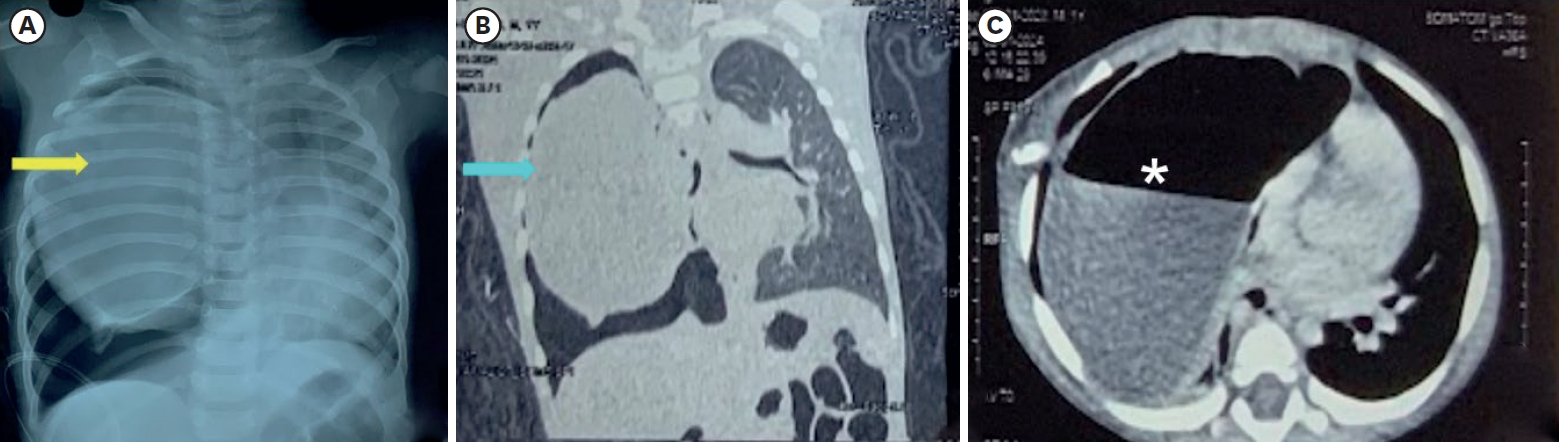
Intrapulmonary bronchogenic cysts are rare congenital anomalies that often present diagnostic and management challenges due to nonspecific symptoms. We report a one-year-old female with progressive respiratory distress who was initially misdiagnosed with pneumothorax. Imaging revealed a large intrapulmonary cyst, and surgical excision confirmed the diagnosis. Early intervention ensured a favorable outcome, with no recurrence in one year. This case highlights the importance of considering bronchogenic cysts in pediatric respiratory distress and emphasizes the value of timely surgical management.
  • 30 View
  • 4 Download
[English]
Ciliated Foregut Cyst of the Gallbladder: A Rare Entity of Childhood
Balla Lohith Raja Sekhar, Nitin James Peters, Jitender Singh, Shailesh Solanki, Kirti Gupta, Ravi Prakash Kanojia, Jai Kumar Mahajan
Adv Pediatr Surg 2025;31(1):31-35.   Published online June 9, 2025
DOI: https://doi.org/10.13029/aps.2025.31.1.31
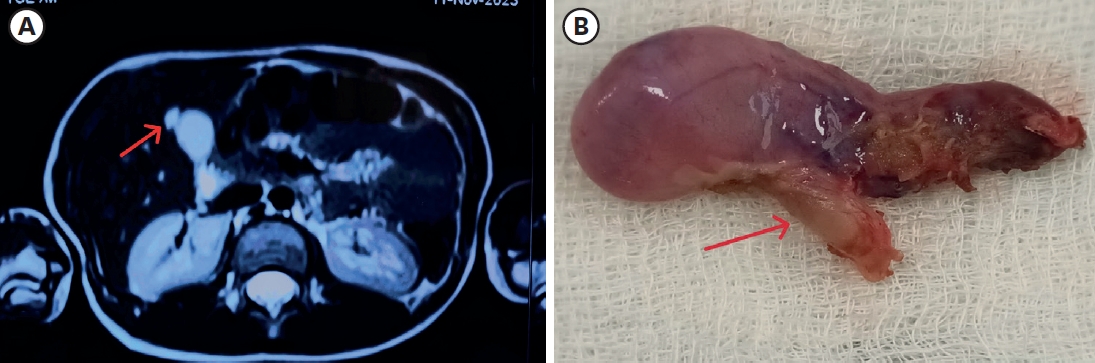
A ciliated foregut cyst is a rare developmental anomaly. It develops from the primitive foregut. It is usually located supra-diaphragmatically. Its localization in the gallbladder is very infrequent and has been sparsely reported. We report a rare case of a ciliated cyst of the gallbladder in an 11-year-old female, who presented with complaints of upper abdominal pain for 2 months. She was suspected to have gallbladder duplication or gallbladder diverticulum on imaging. The histopathology reported this anomaly as a ciliated foregut cyst. The ciliated cyst of the gallbladder is a benign congenital lesion. Abdominal ultrasonogram and computed tomography/magnetic resonance imaging are suggestive of a cystic lesion of the gallbladder. The definitive diagnosis is by histopathological examination. This is a rare clinicopathological condition in the pediatric age group. The recommended treatment is laparoscopic cholecystectomy. The role of conservative management has not been established due to the rarity of the condition.
  • 27 View
  • 1 Download
[English]
Morgagni Hernia Masquerading as a Congenital Heart Disease in a Neonate: A Case Report
Sheetal Upreti, Shailesh Solanki, Shivani Dogra, Jai K Mahajan
Adv Pediatr Surg 2024;30(1):28-31.   Published online May 27, 2024
DOI: https://doi.org/10.13029/aps.2024.30.1.28
Morgagni hernia (MH) is a type of congenital diaphragmatic hernia that is rare and without any distinctive presentation. Chest radiographs can miss the diagnosis when solid organs instead of bowel loops are herniated. Echocardiography can perplex the diagnosis instead of aiding if MH is not suspected. We are here discussing the presentation and management of a neonate with MH, which was referred to our institute as a congenital heart disease.
  • 14 View
  • 1 Download
[English]
Hirschsprung Disease Associated With Pelvic Neuroblastoma: A Rare Neurocristopathic Association
Sravanthi Vutukuru, Nitin J Peters, Shailesh Solanki, Amita Trehan, Kirti Gupta, Monika Bawa
Adv Pediatr Surg 2024;30(1):32-37.   Published online January 29, 2024
DOI: https://doi.org/10.13029/aps.2024.30.1.32
Hirschsprung disease (HSCR) is a genetic disorder with an incidence of 1:5000, seen in the pediatric age group. The association between HSCR and neuroblastoma (NBL), ends of the neurocristopathy spectrum is rare. Less than 10 cases of this association are reported in the literature and the association between the Phox gene and Sox10 gene in the pathophysiology of these is being studied. We report a one-year-old baby, who presented to us, with chronic constipation on regular enemas and laxative usage. There was a history of delayed passage of meconium. At the time of Duhamel’s pull through a well-defined, bilobed hard presacral mass, was encountered. Excision and coccygectomy were done and the pull was completed. The histopathology showed a well-differentiated NBL. Fludeoxyglucose positron emission tomography scan and the N-Myc amplification were negative and the patient was managed with expectant treatment. She is doing well over a 3-year follow-up with no recurrence and good resolution of bowel functions.
  • 15 View
  • 0 Download
[English]
Congenital Anomaly of Ribs Masquerading as Diaphragmatic Hernia in an Infant: A Case Report
Priyanka Mittal, Shailesh Solanki, Prema Menon
Adv Pediatr Surg 2019;25(1):20-23.   Published online June 26, 2019
DOI: https://doi.org/10.13029/aps.2019.25.1.20

Congenital absence/hypoplasia/fusion of ribs are very rare anomalies and presentation varies from asymptomatic to life-threatening. Visibly evident cases are straightforward to diagnose but this is not always the case. Familiarity and awareness of these anomalies can help to diagnose cases with subtle signs and symptoms. Proper radiological investigations are vital for anatomical delineation. Absence or hypoplasia of the inferior ribs along with its attached muscles can cause ‘lung hernia’ that produces an unstable chest leading to paradoxical respiratory movements. Here, we present a case of hypoplastic and fused ribs in an infant, who presented with respiratory distress and created a diagnostic dilemma.

  • 14 View
  • 0 Download

Original Article

[English]
Purpose

The introduction of Malone antegrade continence enema) in the management of children with fecal incontinence has brought remarkable improvement in patient care, Malone originally described appendix as a conduit and it has become widely accepted. However, surgeons are faced with situations where appendix is not available, the selection and creation of other conduit is always a challenge. We present our technique and experience with the use of alternative catheterizable conduits for antegrade continence enema (ACE).

Methods

Retrospective review of children who underwent ACE procedure in our institution from March 2009 to January 2014. The details retrieved: indication, reason for non availability of appendix, type of conduit, complications and patient's satisfaction.

Results

Five children were identified in whom the appendix was not available or suitable. In four children cecal/colon-based flap was used and in one child, ileal (Monti) segment was used to create a conduit. The mean follow-up was 3.2 years. All patients were satisfied with the procedure and no stenosis or loss of conduit was noted in the follow-up.

Conclusion

Continent catheterizable conduit for ACE can be accomplished with transverse tubularized intestinal segments and cecal/colonic flaps, with excellent outcome, irrespective of tissue used. Surgeon's preference and the patient's peculiar anatomy should determine the surgical technique to be used.

  • 25 View
  • 1 Download