

Skip to main navigation Skip to main content
  • KAPS
  • E-Submission

APS : Advances in Pediatric Surgery

OPEN ACCESS
ABOUT
BROWSE ARTICLES
EDITORIAL POLICY
FOR CONTRIBUTORS

Page Path

4
results for

"Kasai procedure"

Article category

Keywords

Publication year

Authors

Funded articles

"Kasai procedure"

Original Articles

[English]
A Comparative Study of Three National Surveys on Biliary Atresia by the Korean Association of Pediatric Surgeons
Yeon Jun Jeong, Dayoung Ko, Hyunhee Kwon, Ki Hoon Kim, Dae Yeon Kim, Soo-Hong Kim, Wontae Kim, Hae-Young Kim, Hyun Young Kim, Seong Chul Kim, Younghyun Na, Jung-Man Namgoong, So Hyun Nam, Junbeom Park, Jinyoung Park, Tae-Jun Park, Jeong-Meen Seo, Ji-Young Sul, Joonhyuk Son, Hyun Beak Shin, Joohyun Sim, Soo Min Ahn, Hee Beom Yang, Jung-Tak Oh, Chaeyoun Oh, Joong Kee Youn, Sanghoon Lee, Ju Yeon Lee, Kyong Ihn, Hye Kyung Chang, Eunyoung Jung, Jae Hee Chung, Yu Jeong Cho, Yun Mee Choe, Soo Jin Na Choi, Seok Joo Han, In Geol Ho, Ji-Won Han
Adv Pediatr Surg 2025;31(2):47-58.   Published online July 16, 2025
DOI: https://doi.org/10.13029/aps.2025.31.2.47
Purpose
Biliary atresia (BA) is a rare but progressive cholangiopathy and the leading cause of pediatric liver transplantation worldwide. The Korean Association of Pediatric Surgeons (KAPS) has conducted three national surveys (2001, 2011, and 2023) to assess long-term trends in the diagnosis, treatment, and outcomes of BA. This study provides a comparative analysis of the 2nd and 3rd national surveys, with reference to selected findings from the 1st survey.
Methods
This study included 453 patients from the 3rd national survey (2011–2021) and 435 patients from the 2nd survey (2001–2010), all of whom underwent Kasai portoenterostomy. Data were collected via electronic case report forms from pediatric surgical centers nationwide. Comparisons were made regarding demographics, clinical features, diagnostic patterns, operative details, follow-up outcomes, and survival. Kaplan–Meier analysis was used to evaluate long-term survival.
Results
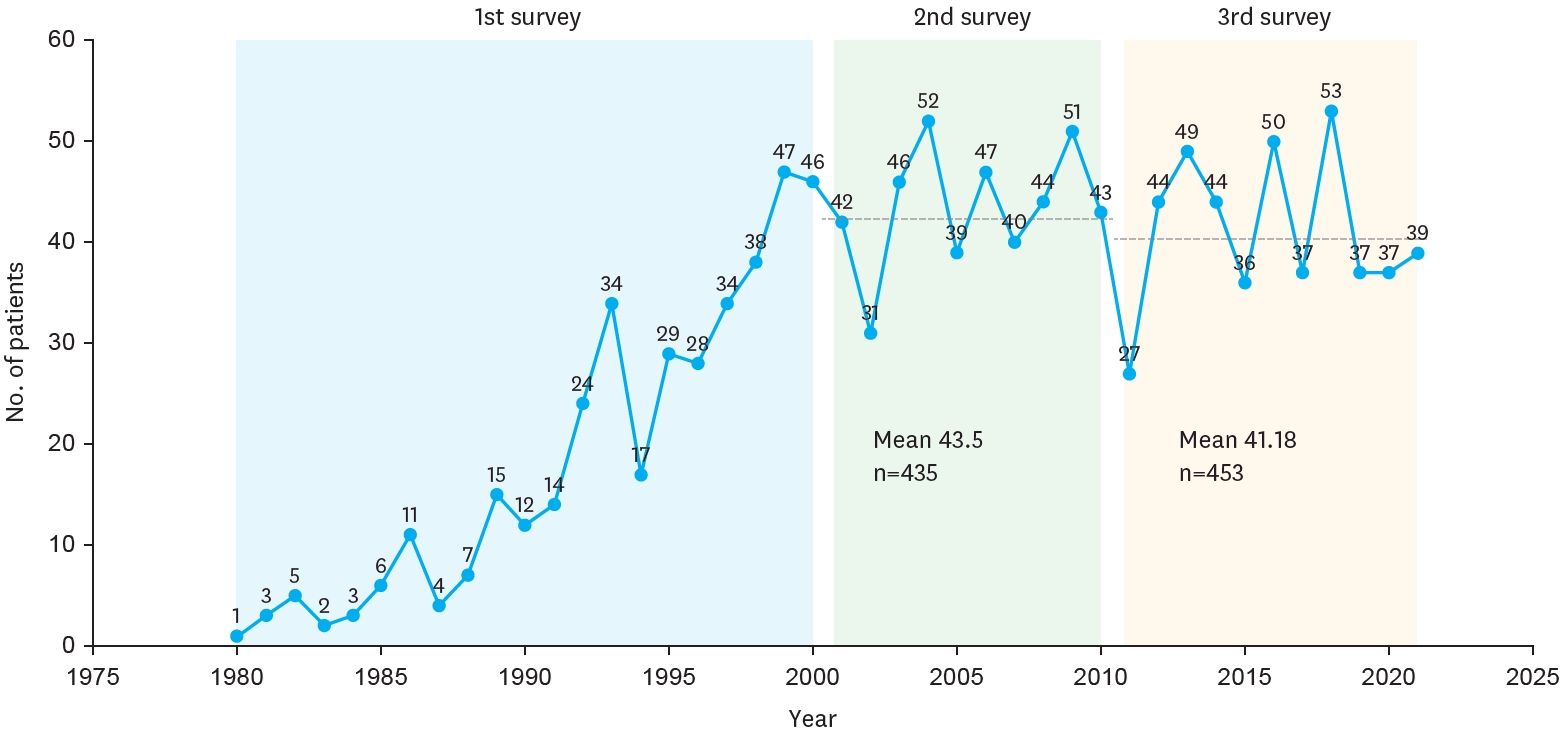
The mean number of BA patients per year remained stable between surveys (43.5 in the 2nd, 41.18 in the 3rd), though centralization of care increased, with 61.5% of cases managed by two major institutions in the 3rd survey. The median age at surgery decreased, and the use of preoperative imaging (especially magnetic resonance cholangiopancreatography) increased. The 10-year native liver survival rate declined from 59.8% to 53.7%, while overall 10-year survival improved slightly (92.9% to 93.2%). Postoperative complications, such as cholangitis and liver failure, persisted but were better categorized. The 3rd survey also reported improved mortality (4.9%) and reduced follow-up loss (11.5%) compared to the 2nd survey.
Conclusion
While overall survival after Kasai operation has remained high and even improved, native liver survival has slightly declined. The findings reflect earlier diagnosis, more consistent diagnostic imaging, and increasing centralization of care. These trends underscore the importance of long-term nationwide data collection in guiding future strategies for BA management in Korea.
  • 35 View
  • 4 Download
[English]
Outcome of Patients Undergoing Kasai Procedure for Biliary Atresia: a Study of Those Surviving More Than 10 Years with Their Native Livers
Byung Hun Yim, Young Tack Song, Jae Hee Chung
J Korean Assoc Pediatr Surg 2008;14(2):125-133.   Published online December 31, 2008
DOI: https://doi.org/10.13029/jkaps.2008.14.2.125

To evaluate the long-term prognosis of biliary atresia after Kasai operation, a total of 14 patients (of the 41 patients operated upon from 1982 to 1997), who had been followed up for more than 10 years, were included in this retrospective study. Eleven out of 14 patients survived with their native livers, and their data analyzed for age at operation, clearing time of jaundice, histological outcome, postoperative complications, effectiveness after the application of an intussusception anti-reflex valve, and quality of life. Average age at surgery was 62.8 days. Serum bilirubin was normalized within three months in all patients. Six among the eleven long-term survivors had ascending cholangitis as one of the postoperative complications. The application of an intussusception anti-reflux valve did not show any statistical significance in long-term survival. Most of long-term survivors appeared to enjoy good quality of life. Kasai operation might not be the definitive treatment for biliary atresia; however, Kasai operation made it possible to achieve long-term survival for patients with biliary atresia when the patients were detected and treated as early as possible.

  • 6 View
  • 0 Download
[English]
Clinical & Nutritional Assessments of Long-term Survivors of Biliary Atresia
Yong Soon Chun, Woo Ki Kim
J Korean Assoc Pediatr Surg 1998;4(2):125-130.   Published online December 31, 1998
DOI: https://doi.org/10.13029/jkaps.1998.4.2.125

To assess the clinical and nutritional status of long-term survivors of biliary atresia, history taking, medical record review, physical examination (height, weight, MAC, TSF), blood tests (LFT, prothrombin time, platelet count, prealbumin, calcium) and liver needle biopsy were performed in 12 patients in whom Kasai procedure were performed more than 10 years ago at Department of Pediatric Surgery in Seoul National University Hospital. None were below the 5th percentile in height and weight. TSF was above the 75th percentile in all patients and showed good subcutaneous fat deposition. MAC was above the 5th percentile in all patients. Serum prealbumin level was abnormal in 2 patients with abnormal liver function and revealed visceral protein malnutrition. Serum calcium level was decreased below normal range in 4 patients with abnormal liver function. One patient had mild ascites. Five patients had abnormal liver function and 7 patients showed clinical manifestation of portal hypertension. Liver needle biopsy was performed in 5 patients and no cirrhotic change was observed. Although some patients who have survived for more than 10 years after Kasai procedure developed protein malnutrition and vitamin deficiencies, growth and development and nutritional status were generally satisfactory. Five patients(42%) showed normal liver function and no portal hypertension. In conclusion, Kasai procedure is satisfactory as a primary treatment in biliary atresia but significant portion of long-term survivors had abnormal liver function and portal hypertension. Continuous and careful follow-up is necessary to determine when liver transplantation may be indicated.

  • 5 View
  • 0 Download

Case Report

[English]
Biliary Atresia Splenic Malformation With Situs Inversus: A Case Report
Solanki, Shailesh , Kanojia, Ravi , Reddy, Manasa , Ahmad, Mohammad Fahim , Lal, Sadhna B , Samujh, Ram
Adv Pediatr Surg 2022;28(1):17-20.
DOI: https://doi.org/10.13029/aps.2022.28.1.17
Biliary atresia is a progressive sclerosing cholangiopathy of bile ducts. Most of the time it is an isolated anomaly but can present with syndromic forms. The biliary atresia splenic malformation (BASM) syndrome is associated with splenic anomalies, vascular anomalies, and visceral asymmetry along with biliary atresia. The surgical anatomy of BASM is distinctive and creates a challenge for the surgeons. We are describing a case of BASM with situs inversus and highlighting the approach, intraoperative anatomy, and surgical intricacies of Kasai portoenterostomy in such a situation with the review of pertinent literature.
  • 9 View
  • 0 Download