

Skip to main navigation Skip to main content
  • KAPS
  • E-Submission

APS : Advances in Pediatric Surgery

OPEN ACCESS
ABOUT
BROWSE ARTICLES
EDITORIAL POLICY
FOR CONTRIBUTORS

Page Path

10
results for

"Intestinal atresia"

Article category

Keywords

Publication year

Authors

"Intestinal atresia"

Original Article

[English]
Comparative Analysis of National Surveys of Intestinal Atresia: A Retrospective Study by the Korean Association of Pediatric Surgeons
Jinyoung Park, Dayoung Ko, Eun-jung Koo, Hyunhee Kwon, Ki Hoon Kim, Dae Yeon Kim, Seong Chul Kim, Soo-Hong Kim, Wontae Kim, HaeYoung Kim, Hyun-Young Kim, So Hyun Nam, Jung-Man Namgoong, Junbeom Park, Taejin Park, Min-Jung Bang, Jeong-Meen Seo, Ji-Young Sul, Joonhyuk Son, Joohyun Sim, Soo Min Ahn, Hee-Beom Yang, Jung-Tak Oh, Chaeyoun Oh, Joong Kee Youn, Sanghoon Lee, Ju Yeon Lee, Kyong Ihn, Hye Kyung Chang, Yeon Jun Jeong, Eunyoung Jung, Jae Hee Chung, Min Jeong Cho, Yun-Mee Choe, Seok Joo Han, In Geol Ho, Jeong Hong
Adv Pediatr Surg 2025;31(1):8-15.   Published online May 28, 2025
DOI: https://doi.org/10.13029/aps.2025.31.1.8
Purpose
This study aims to investigate and compare the incidence, demographic characteristics, clinical manifestations, preoperative diagnostic methods, anatomical classifications, associated anomalies, operative treatments, and postoperative outcomes of patients with intestinal atresia treated by the members of the Korean Association of Pediatric Surgeons (KAPS) through three nationwide surveys.
Methods
KAPS conducted 3 national surveys in 1998, 2010, and 2024 to examine the patients diagnosed with intestinal atresia. In preparation for the survey, we developed a customized case registration form to obtain data on patient sex, birth weight, gestational age, clinical manifestations, preoperative diagnostic methods, anatomical types, associated anomalies, operative treatments, and postoperative outcomes. Authorized KAPS members completed the case registration form.
Results
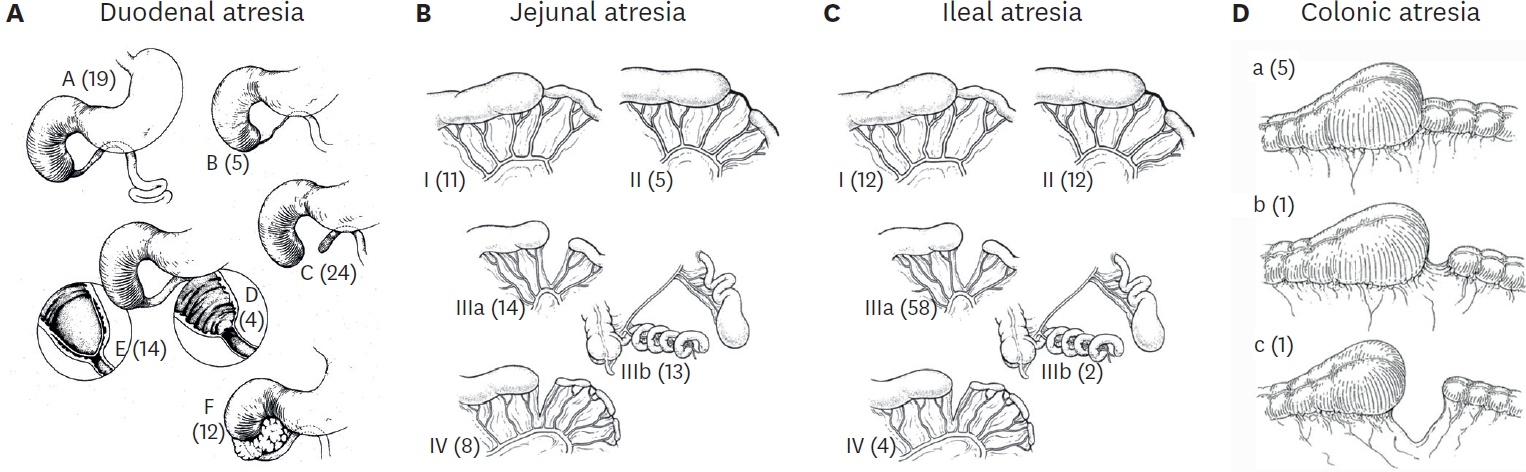
The first, second, and third national surveys included 218, 222, and 236 individuals diagnosed with intestinal atresia, respectively. The male-to-female ratios were 1.5:1, 1.1:1, and 1.1:1, respectively. The first, second, and third national surveys revealed that 34.3%, 43.3%, and 53.4% of patients were born before 37 weeks of gestation, respectively. Additionally, 28.7%, 32.0%, and 40.7% of patients had a birth weight under 2,500 g. In the third national survey, duodenoduodenostomy was the most common procedure, performed in 70 out of 82 patients diagnosed with duodenal atresia. Resection and anastomosis were the main surgical procedures conducted in 47 out of 54 cases of jejunal atresia and 74 out of 92 cases of ileal atresia. The mortality rates in the first, second, and third national surveys were 13.8%, 3.6%, and 1.3% respectively, with the lowest rate observed in the third national survey.
Conclusion
These national surveys offer valuable insights into the current state of intestinal atresia, including specific surgical interventions and postoperative outcomes in South Korea. For pediatric surgeons aiming to enhance their understanding of intestinal atresia and its treatment options, these surveys could be an indispensable resource and guide.
  • 28 View
  • 2 Download

Case Report

[English]
Intestinal failure (IF) is a term used to define the state where intestine’s function is significantly reduced, to the point where adequate growth and hydration cannot be maintained. In such cases, intravenous nutritional support is essential for sustaining the patient’s life. In pediatric patients, the most common cause of IF is short bowel syndrome (SBS). Due to the prolonged treatment and high complication rates, management of SBS remains a continuous challenge to many physicians. Herein, we report the case of a 2,260 g premature female infant born at 35-week gestational age with type 4 jejunoileal atresia. She presented with ultrashort bowel syndrome, having a bowel length of less than 15 cm, but ultimately achieved gut autonomy and restored bowel function through successful intestinal rehabilitation within the first two years of life.
  • 30 View
  • 2 Download

Original Articles

[English]
Santulli Enterostomy: A Considerable Method for Patients Who Require Proximal Enterostomy
Kyong Ihn, Eun-Jung Koo, In Geol Ho, Seok Joo Han, Jung-Tak Oh
J Korean Assoc Pediatr Surg 2018;24(1):20-25.   Published online June 30, 2018
DOI: https://doi.org/10.13029/jkaps.2018.24.1.20
Purpose

Santulli enterostomy has been used for various surgical abdominal conditions that require temporary diversion of bowel during a neonatal period. The aim of this study was to report clinical outcomes of Santulli enterostomy and to evaluate its usefulness.

Methods

Between January 2000 and December 2016, 40 neonates who underwent Santulli enterostomy were enrolled; Santulli enterostomies were performed for 25 patients without previous laparotomy (primary Santulli group) and 15 patients with previous laparotomy (secondary Santulli group).

Results

Small bowel atresia is the first common indication of Santulli enterostomy (22/40, 55.0%), and luminal discrepancy between proximal and distal bowel was the most common determinant factor of Santulli enterostomy (17/40, 42.5%). The median age at surgery and mean birth weight were 2 days and 2,480 g respectively in the primary group, and 71 days, 2,340 g respectively in the secondary group. Operation time was significantly longer in the secondary group than the primary group (156±48 minutes vs. 224±95 minutes, p=0.019), and there was no difference in the time taken to initiation of oral feeding between the two groups. Santulli enterostomy closure was performed at median 65 days after Santulli enterostomy for primary group and 70 days for secondary group. Six complications (15.0%) were found after Santulli enterostomy, and nine complications (24.3%) after Santulli enterostomy closure (p=0.302). The incidence of complications was significantly higher in secondary group than in primary group (4.5% vs. 53.3%, p=0.001), and the reoperation rate was also significantly higher in the secondary group (4.5% vs. 46.7%, p=0.004).

Conclusion

Santulli enterostomy could be applied as a temporary enterostomy in neonatal patients with various surgical abdominal diseases. Considering the high complication rate after secondary Santulli enterostomy closure, decision making on the timing of enterostomy closure should be done with caution.

  • 6 View
  • 0 Download
[English]
Intestinal Atresia: The Second National Survey
S C Kim, D Y Kim, S Y Kim, I K Kim, I S Kim, J E Kim, J C Kim, H Y Kim, K W Park, W H Park, J Y Park, J M Seo, J Y Seol, S M Oh, J T Oh, N H Lee, M D Lee, S K Lee, S C Lee, S Y Chung, S E Jung, Y J Jeong, P M Jung, K J Choi, S JN Choi, S O Choi, S H Choi, Y M Choi, S J Han, J Hong
J Korean Assoc Pediatr Surg 2010;16(1):1-10.   Published online June 30, 2010
DOI: https://doi.org/10.13029/jkaps.2010.16.1.1

The members of the Korean Association of Pediatric Surgeons conducted a retrospective study of two hundred and twenty-two cases of intestinal atresia for the period from January 1, 2007 to December 31, 2009. Seventeen hospitals were involved. There were 76 duodenal, 65 jejunal, and 81 ileal atresias (3 colonic). The male to female ratio was 0.85:1 in DA and 1.34:1 in JIA. Ninety-four patients(43.3%) were premature babies (DA 40.3%, JA 64.6%, IA 28.8%), and 70 babies (32.0%) had low birth weight (DA 38.7%, JA 44.4%, IA 16.0%). Antenatal diagnosis was made in 153 cases (68.9%). However, 27 infants (17.6%) with antenatal diagnosis were transferred to the pediatric surgeon's hospitals after delivery. Maternal polyhydramnios was observed in 81 cases (36.59%) and most frequent with proximal obstruction. In forty-four cases (19.8%), only simple abdominal film was taken for diagnostic study. The associated malformations were more frequently observed in DA - 61.8% in DA and 22.6% in JIA. Meconium peritonitis, small bowel volvulus and intussusception were more frequently associated with ileal atresia. The overall mortality rate was 3.6%.

  • 7 View
  • 0 Download
[English]
Experience with Tapering Enteroplasty in Intestinal Atresia
Jae Hee Chung, Soo Hong Kim, Young Tack Song
J Korean Assoc Pediatr Surg 2007;13(1):23-29.   Published online June 30, 2007
DOI: https://doi.org/10.13029/jkaps.2007.13.1.23

Tapering enteroplasty was first described by Thomas in 1969 as one method of intestinal anastomosis. The advantages of tapering enteroplasty in the intestinal atresia are: First, it makes end-to-end anastomosis possible between the atretic bowel ends with considerable differences in diameters. Second, it promotes the recover of the postoperative bowel function. Third, it prevents the possibility of the short bowel syndrome by eliminating the need of resecting the dilated bowel. A total of 22 patients with intestinal atresia who underwent tapering enteroplasty from January 1988 to December 2005 at our institute were reviewed. In 3 of 22 cases, tapering enteroplasty was the 2nd operation after an initial end-to-oblique anastomosis. We reviewed the following items: age, sex, type and location of intestinal atresia, initial feeding and total enteral feeding start day, the length of hospital stay and complications. The average age of the patients was 7 days. Male to female ratio was 1 to 1.2 (10 cases: 12 cases). We performed the tapering enteroplasty on all types and locations of the intestinal atresia from the duodenum to the colon: type I (n=3), type II (n=4), type IIIA (n=7), type IIIB (n=5), type IIIB and IV (n=1), type IV (n=1) and type C (duodenum) and type IIIB and IV (jejunum). On the average, the oral feeds were started on the postoperative 8.8th day, and full caloric intake via the enteric route was achieved on postoperative 13.3th day. The average length of hospital stay was 19.6 days. There were 1 case (4.5 %) of anastomotic complication and 2 cases (9 %) of adhesive ileus among 22 patients. The tapering enteroplasty on all types of intestinal atresia is a usefull operative method when there are considerable diameter differences between the atretic bowel ends.

  • 5 View
  • 0 Download
[English]
Intestinal Atresia: A Survey by the Korean Association of Pediatric Surgeons
IK Kim, SY Kim, SK Kim, WK Kim, JE Kim, JC Kim, HH Kim, KW Park, YS Park, WH Park, YT Song, JW Yang, SM Oh, SY Yoo, DS Lee Lee, SK Lee, SC Lee, SI Chang, SY Chung, SE Chung, ES Chung, PM Jung, MH Cho, KJ Choi, SO Choi, SH Choi, YS Huh, C Hong, EH Whang
J Korean Assoc Pediatr Surg 1999;5(1):75-81.   Published online June 30, 1999
DOI: https://doi.org/10.13029/jkaps.1999.5.1.75

A survey on intestinal atresia was made among 34 members of Korean Association of Pediatric Surgeons about the patients who were treated from the January 1, 1994 to December 31, 1996. The response rate was 82.4%. Two hundred and fifteen patients were analyzed. The lesion occurred in 73 cases at duodenum, in 72 cases at jejunum, in 71 cases at ileum and 2 cases at cecum and sigmoid colon each. There were 2 cases of combined anomalies (DA + JA + IA and DA + JA). Male to female ratio was 1:1 in duodenal atresia. and 1.8:1 in jejunoileal atresia. Seventy-four cases (34.3%) were premature babies (DA 35.2%, JA:48.6%, IA:19.2%), and 62 cases (28.7%) had low birth weight (DA:39.4%, JA 33.0%, IA:13.7%). Antenatal diagnosis was made in 92 cases (43.6%). However 22 cases (23.9%) of them were transferred to pediatric surgeon after delivery. Maternal polyhydramnios was observed in 63 cases (28.9%). Seventy-five cases (34.4%) were taken only simple abdominal film for diagnostic studies. The associated malformations were observed in 54 cases (24.8%) of intestinal aresia and more frequently observed in duodenal atresia (35 cases, 47.9%). Meconium peritonitis due to intrauterine bowel perforation was more frequently associated with ileal atresia compared to duodenum and jejunum. The overall mortality rate was 30%. (Abbreviations: DA;duodenal atersia, JA;jejunal atresia, IA;ileal atrsia, PT;p-value in total, PDJ,DI,JI;p-value between two groups among duodenal, jejunal and ileal groups)

  • 6 View
  • 0 Download
[English]
A Clinical Study of Congenital Intestinal Atresia and Stenosis
Sang Woo Kim, Poong Man Jung
J Korean Assoc Pediatr Surg 1997;3(2):117-125.   Published online December 31, 1997
DOI: https://doi.org/10.13029/jkaps.1997.3.2.117

Seventy neonates with congenital intestinal atresia and stenosis who were treated at pediatric surgical service, Hanyang University Hospital from September 1979 to December 1996 were analyzed retrospectively. The lesion occurred in 27 cases at the duodenum, in 26 cases at the jejunum, in 13 cases at the ileum and in 2 cases at the pylorus and colon each. There were 10 multiple atresias and 7 apple-peel anomaly cases. The atresia predominated over the stenosis by the ratio of 4 : 1. Male to female ratio was 1.3 : 1. The average gestational age was 38 weeks, and the average birth weight was 2,754 grams. Though 22.9 % were borne prematurely and 34.3 % had low birth weight, 92.3 % of them had a weight appropriate for gestational age. Polyhydramnios(40 %) was more frequently observed in duodenal and jejunal atresia while microcolon in ileal atresia(58.3 %). Weight loss and electrolyte imbalance occurred more frequently in the duodenal stenosis cases because of delayed diagnosis. Twenty(55.6 %) of 37 jejunoileal atresia cases had evidence of intrauterine vascular accident: 4 intrauterine intussusception, 3 intrauterine volvulus and 3 strangulated intestine in gastroschisis, and 10 cases of intrauterine peritonitis. There were one or more associated anomalies in 45 patients(64.3 %). Preoperatively proximal loop volvulus developed in 3 cases and proximal loop perforation in 5 cases and one case each of distal loop perforation, duodenal perforation and midgllt volvulus occurred in the jejunoileal atresia. Overall mortality rate was 20 %.

  • 4 View
  • 0 Download

Review Article

[English]
Jejunoileal atresia (JIA) is a rare congenital disorder in newborns leading to intestinal obstruction, necessitating urgent surgery. A delay in diagnosis can result in severe complications like sepsis, bowel perforation, and even death. Over the years, improvements in neonatal care, surgical techniques, and nutrition have led to a marked decrease in mortality rates for JIA patients. While the exact cause remains uncertain, it is thought to result from an ischemic insult during later in utero. JIA is categorized into 4 types, detailing the structure and implications of each type. Clinically, mothers may exhibit polyhydramnios, and infants usually present with symptoms like bilious vomiting and abdominal distension. A significant percentage of affected infants do not pass meconium within the first day of life. Diagnosis is commonly through abdominal radiographs, with some cases requiring contrast enemas. Once diagnosed, immediate surgery is advised, with the primary goal to restore intestinal function and length. Nowadays, the survival rate for JIA patients exceeds 90%. This improvement is attributed to a better understanding of the condition, advancements in surgical techniques, and the introduction of total parenteral nutrition. The prognosis varies, with short bowel syndrome being a significant factor determining the outcome. Short bowel syndrome’s prognosis depends on the remaining small bowel length, the ileocecal valve’s presence, and dependence on long-term nutrition. In conclusion, the treatment and prognosis for JIA have seen substantial improvements due to advances in medical care. Early diagnosis and intervention are crucial. While many patients lead a normal life, those with complications like short bowel syndrome may require long-term care. Future efforts should emphasize refining surgical techniques, gaining a deeper understanding of JIA, and enhancing postoperative care. There's also a need for more research into JIA’s genetics and etiology.
  • 23 View
  • 0 Download

Original Article

[English]
High Jejunal Atresia: Clinical Characteristics and Treatment
Jeon, Ho Jong , Ho, In Geol , Oh, Jung-Tak
Adv Pediatr Surg 2023;29(2):58-64.
DOI: https://doi.org/10.13029/aps.2023.29.2.58
Purpose
High jejunal atresia occurring near the ligament of Treitz is rare. It is a complicated type of small bowel atresia, and its treatment is challenging. Our study describes the clinical characteristics and proper management of high jejunal atresia.
Methods
We performed a retrospective review of seven neonates who underwent operations for high jejunal atresia between January 2000 and April 2021.
Results
The sex ratio showed a male predominance, and all patients were prenatally diagnosed with small bowel atresia. Six patients presented with a typical triple bubble appearance on the preoperative abdominal film. The location of the atresias were around the ligament of Treitz or less than 10 cm from the ligament of Treitz, and the types of atresia comprised three cases of type I, two of type IIIb, and two of type IV. Five of the seven patients underwent the operation without proximal enteroplasty. The median duration from operation to full feeding was 23 days, with three patients requiring more than a month to reach full feeding. There were no other operation-related complications. At the long-term follow-up, all patients tolerated oral feeding well.
Conclusion
This study indicates that high jejunal atresia close to the ligament of Treitz exhibits a high incidence of type I and complex types of atresia, and that primary anastomosis, without proximal enteroplasty, can be applied through surgical intervention.
  • 20 View
  • 0 Download

Case Report

[English]
Ileal Duplication in a Neonate With Jejuno-Ileal Atresia, Midgut Malrotation and Volvulus
Dudhani, Shreyas , Suman, Bijay , Singh, Ramjeewan , Sinha, Amit Kumar , Kumar, Bindey
Adv Pediatr Surg 2023;29(1):40-44.
DOI: https://doi.org/10.13029/aps.2023.29.1.40
Jejuno-ileal atresia is often associated with various other gut pathologies. A 5-day male presented with bilious vomiting, abdominal distension and non-passage of stools. Exploratory Laparotomy showed a type IIIA ileal atresia with midgut volvulus and atypical malrotation for which Ladd’s Procedure and anastomosis of atretic bowel was done. A fleshy tubular structure extracted from distal bowel showed ileal duplication. In JIA, the vascular theory of pathogenesis is widely accepted with multiple studies to suggest the same. The mechanism being mesenteric ischemia leading to intestinal necrosis, resorption, and atresia. It has been found that abdominal duplication cyst often occurs simultaneously with short bowel, intestinal atresia, stenosis and enteric duplication for which a common vascular pathogenetic mechanism has been suggested. Our case serves as an in vivo description of the proposed theory where the findings may be described elegantly. We describe and discuss the mesenteric ischemia theory in bowel atresia and hope to further our understanding about the same.
  • 11 View
  • 0 Download