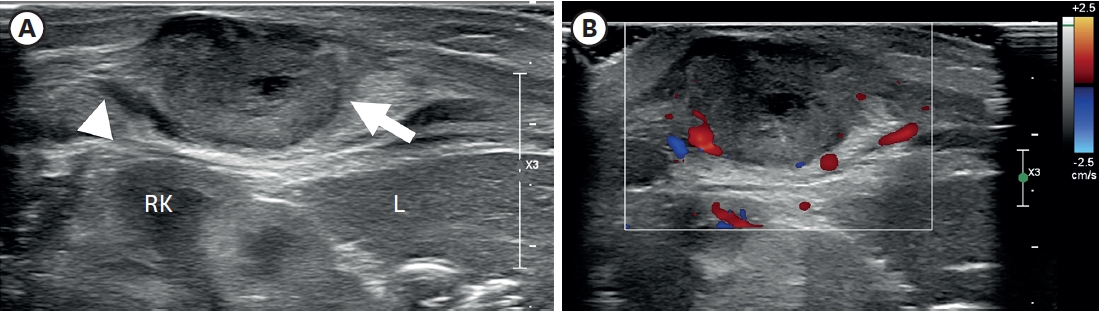
Proliferative myositis (PM) is a rare benign soft tissue neoplasm with a distinctive pseudosarcomatous proliferative reaction of muscles in tumors. Its rapid growth and bizarre microscopic appearance often require a differential diagnosis from a sarcomatous lesion. It has been reported occasionally, mostly as case reports in adult patients. Herein, we present a neonatal case of PM. To the best of our knowledge, this is the first report in the neonatal period.
Purpose Most patients with perinatally detected subhepatic cysts receive information suggestive of a suspected diagnosis of choledochal cyst (CC). However, it is not uncommon to be finally diagnosed with cystic biliary atresia (CBA), a disease with a more unfavorable prognosis. This study aimed to investigate the distribution of the final diagnoses of perinatally detected subhepatic cysts and to compare patients diagnosed with CC and CBA.
Method We performed a retrospective review of patients with subhepatic cysts detected using ultrasonography during perinatal period, between January 2012 and December 2022.
Result This retrospective study included 52 patients with perinatal subhepatic cysts. Of these, 71.2% (37/52) were diagnosed with CC, 15.4% (8/52) with CBA, and 5.8% (3/52) with duplication of the alimentary tract. Only 1.9% (1/52) of the patients were diagnosed with biliary atresia, gallbladder duplication, mesenteric lymphatic malformation, or were normal. Of all patients, 86.5% (45/52) were diagnosed with CC or CBA, with CBA accounting for 17.8% (8/45). There were no statistically significant differences between the CC and CBA groups regarding the gestational age at which the cyst was first detected and the final size of the cyst measured on prenatal ultrasound.
Conclusion Subhepatic cysts detected during the perinatal period are typically diagnosed as CC. However, this study revealed that 15.4% of all patients were diagnosed with CBA, despite no significant differences in prenatal ultrasound findings. Therefore, it is essential to consider the possibility of CBA in cases of perinatally detected subhepatic cysts.
Citations
Citations to this article as recorded by
Prenatal Diagnosis of Isolated Caroli Disease Caused by a Homozygous PKHD1 Variant: A Case Report and Literature Review Hai Wang, Zitong Xu, Xianjue Zheng, Haojie Pan, Yimin Wang, Haiying Chen, Zhenzhen Zheng, Hongping Zhang, Jiayong Zheng Clinical and Experimental Obstetrics & Gynecology.2026;[Epub] CrossRef



 First
First Prev
Prev