

Skip to main navigation Skip to main content
  • KAPS
  • E-Submission

APS : Advances in Pediatric Surgery

OPEN ACCESS
ABOUT
BROWSE ARTICLES
EDITORIAL POLICY
FOR CONTRIBUTORS

Page Path

2
results for

"Duplication cyst"

Article category

Keywords

Publication year

Authors

"Duplication cyst"

Original Article

[English]
Purpose
Enteric duplication cysts (EDCs) are rare congenital anomalies of the gastrointestinal tract. This study aimed to delineate the clinical, anatomical, and pathological spectrum of EDCs based on a 40-year single-center experience.
Methods
A retrospective review was conducted of 45 pediatric patients who underwent surgical treatment for EDCs at a single institution between 1985 and 2023. Clinical records, imaging studies, and pathological reports were analyzed.
Results
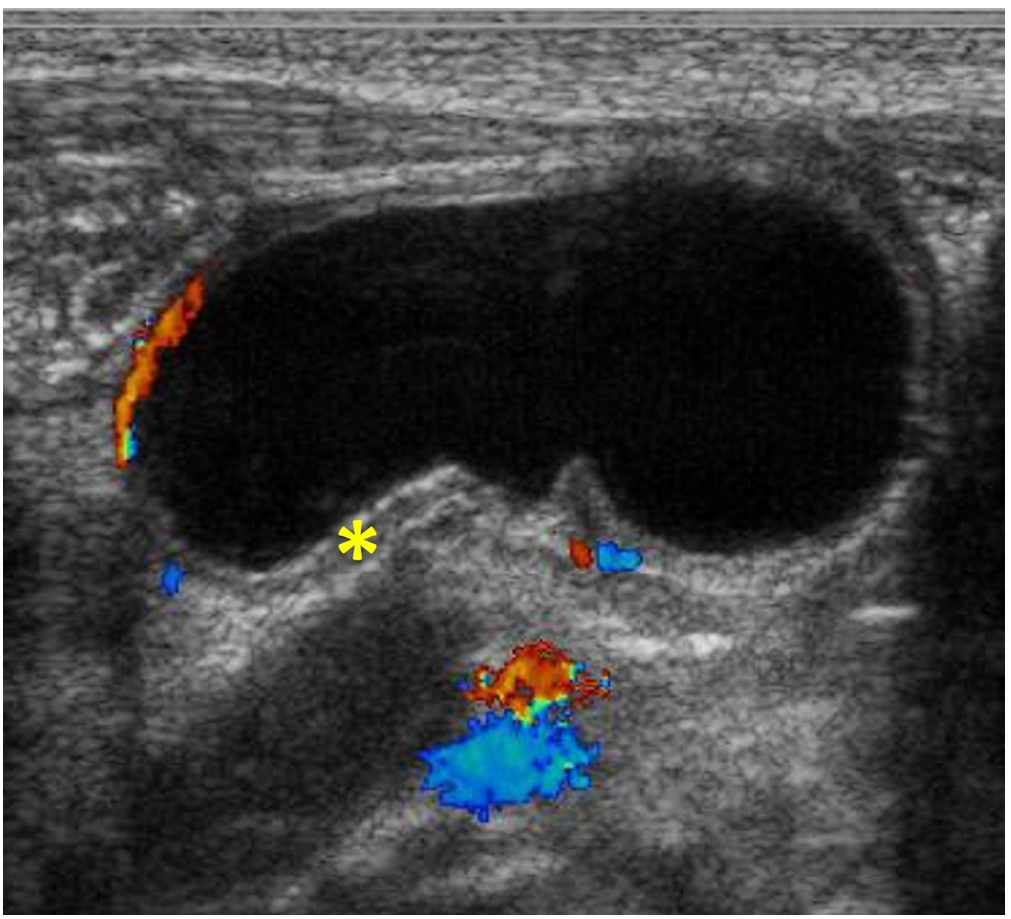
The study included 28 males and 17 females, with a median age at surgery of 4.7 months. Most patients (75.6%) underwent surgery before 2 years of age. The ileum was the most common location (57.8%), followed by the jejunum (11.1%) and ileocecal valve (11.1%). Vomiting (46.7%) was the most common presenting symptom. Emergency surgery was required in 28.9% of cases because of complications such as volvulus or intussusception. Preoperative imaging using ultrasonography (US) and/or computed tomography resulted in a correct diagnosis in 34 of 45 patients (75.6%), with EDCs correctly identified in 30 patients (66.7%), frequently based on the characteristic “double wall sign” observed on US. Histopathological examination identified heterotopic gastric mucosa in 61.4% of evaluable cases. Postoperative outcomes were generally favorable, with a median hospital stay of 7.5 days.
Conclusion
EDCs are rare congenital anomalies that are primarily diagnosed during early childhood. The ileum is the most frequent site of involvement, and clinical presentation is often related to acute complications. Prompt and complete surgical excision remains the definitive treatment and leads to favorable short-term postoperative outcomes, with no recurrence observed during the available follow-up period.
  • 276 View
  • 14 Download

Case Report

[English]
“Intraluminal” Pyloric Duplication: A Case Report
Kyeong Deok Lee, Yoshifumi Kato, Geoffrey J. Lane, Atsuyuki Yamataka
J Korean Assoc Pediatr Surg 2017;23(1):15-17.   Published online June 26, 2017
DOI: https://doi.org/10.13029/jkaps.2017.23.1.15

We report a neonatal case of “intraluminal” pyloric duplication cyst, causing gastric obstruction after birth. Endoscopy revealed a submucosal cystic lesion approximately 15 mm in size arising from the anterior and inferior surfaces of the pylorus obliterating the pyloric canal. After laparotomy, intraoperative cholangiography was performed, which documented no communication between the cyst and the bilio-pancreatic duct. Gastrotomy was performed transversally over the antrum, and the cyst delivered through the incision. The cyst was incised, the upper part of the cyst wall removed, and a mucosectomy performed on the inner cyst wall of the lower part. The mucosa and muscle of the margin of the cyst were approximated. At follow up of 10 months, the patient is well without any sign of gastric obstruction.

Citations

Citations to this article as recorded by  
  • Prenatal Diagnosis of a Duplication Cyst of the Pylorus Using 3D Ultrasound: A Case Report
    Biserka Knezić Frković, Željka Mihaljević, Natalija Tutavac, Dubravka Baćaj Ivanić, Rajka Lulić Jurjević
    Donald School Journal of Ultrasound in Obstetrics and Gynecology.2025; 19(4): 314.     CrossRef
  • 799 View
  • 2 Download
  • 1 Crossref